


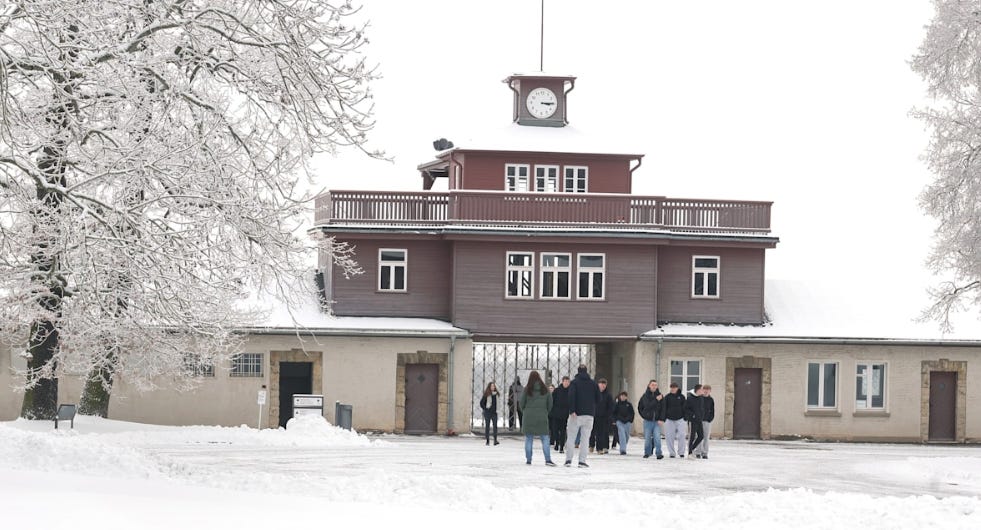
Far-left extremist groups are planning to demonstrate at the Buchenwald concentration camp memorial on April 11-12, 2026—the 81st anniversary of the camp's liberation. The protests, organized under the slogan "Keffiyehs in Buchenwald," emerge from a broader confrontation between the memorial and pro-Palestinian activists over the site's policies regarding political symbols.
The controversy intensified last year when the memorial denied entry to visitors wearing keffiyehs, leading to a legal battle that courts decided in the memorial's favor. Now, the planned demonstrations on liberation weekend—when Buchenwald typically hosts solemn remembrance ceremonies for the approximately 56,000 victims murdered between 1937 and 1945—have drawn sharp condemnation from German officials and memorial leadership who view them exploitation of Holocaust commemoration for anti-Israel political activism.
Origins of the Controversy
The confrontation appears to have begun in April 2025 when Anna M., a Communist Organization member, claims she was denied entry to the memorial while wearing a keffiyeh during the 80th liberation anniversary commemoration.
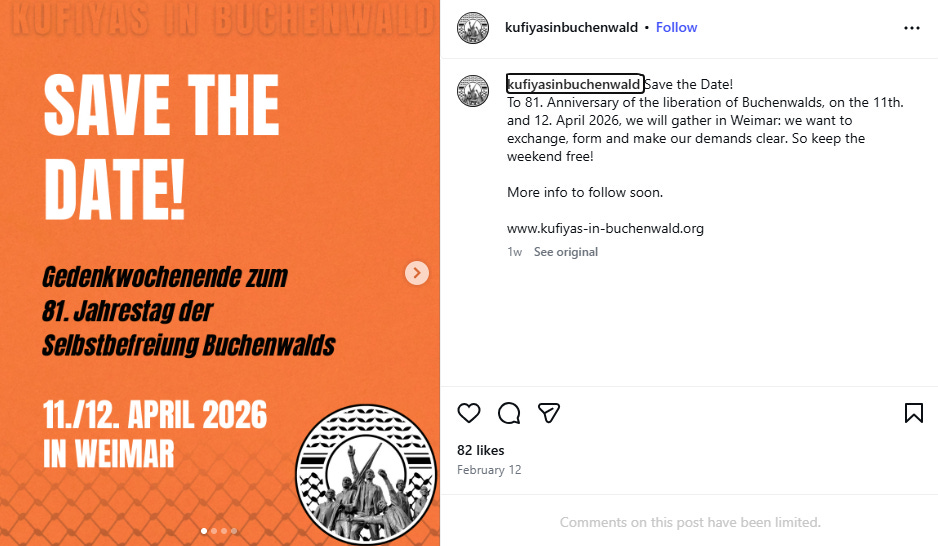
In August 2025, a German court ruled in favor of the memorial foundation, upholding its right to refuse admission to individuals wearing keffiyehs for political demonstrations. This legal defeat appears to have catalyzed the current campaign for demonstrations during the 2026 liberation anniversary.
Extremist Network Behind the Campaign
The organizing group for the demonstrations, “Keffiyehs in Buchenwald,” has published a statement and collected signatures from organizations and individuals supporting its demands. As reported by The Jerusalem Post, the initiative is described as a program of the broader “Kufiyas Network” mobilizing for protest actions around the April 2026 Buchenwald liberation-commemoration weekend.
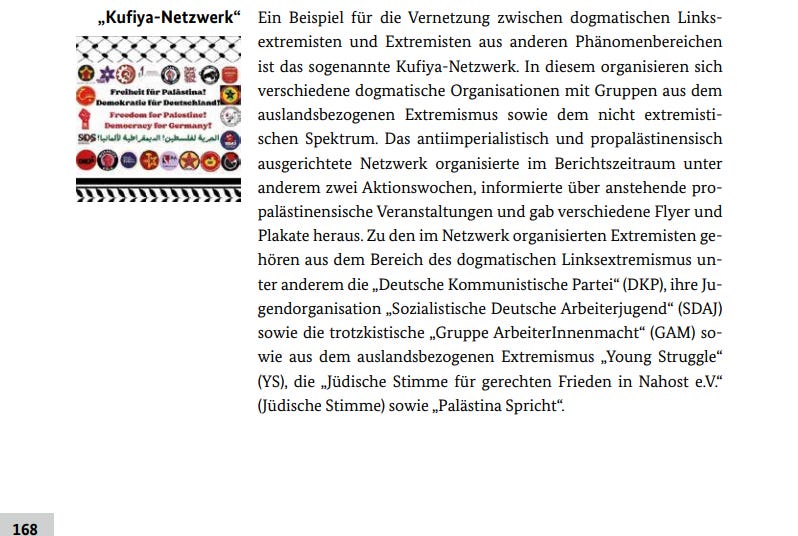
Several of the campaign’s organizational signatories overlap with groups explicitly named in Germany’s 2024 annual report by the Federal Office for the Protection of the Constitution (BfV) in its discussion of the so-called “Kufiya network.” In that passage, the report names the signatory groups the German Communist Party (DKP) and Jewish Voice for a Just Peace in the Middle East among the extremist participants in the network, alongside other listed actors: Socialist German Workers Youth (SDAJ), Workers’ Power (GAM), Young Struggle, and Palestine Speaks.
Page 168 of the intelligence report describes the “Kufiya Network” as an alliance “between dogmatic left-wing extremists and extremists from other areas” that organized action weeks and produced propaganda materials throughout 2024.
The report also states that certain BDS-adjacent actors — including Jüdische Stimme — while ostensibly advocating a two-state solution, “directly or euphemistically” endorse the terrorism of Hamas, Palestinian Islamic Jihad, and the Popular Front for the Liberation of Palestine, and describe the October 7, 2023 attack as a legitimate “act of resistance”.
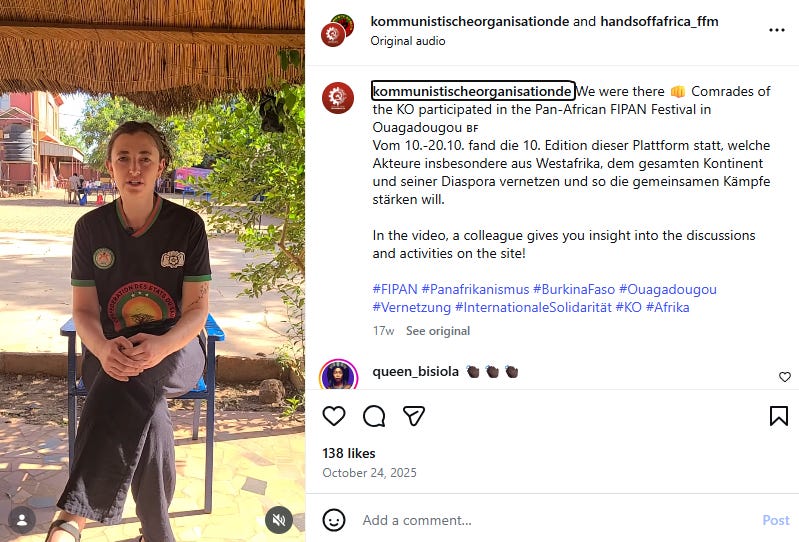
The Communist Organization, which emerged from a 2018 split with the DKP, previously celebrated the October 7 Hamas massacre, calling it a “legitimate uprising by all means necessary”, according to reporting by Israel Hayom.
Notably, Anna M.—the plaintiff who filed the initial lawsuit against the memorial—has been documented on social media appearing in posts from both the Communist Organization and the “Kufiyas in Buchenwald” campaign, indicating what appears to be her ongoing involvement in both organizations.
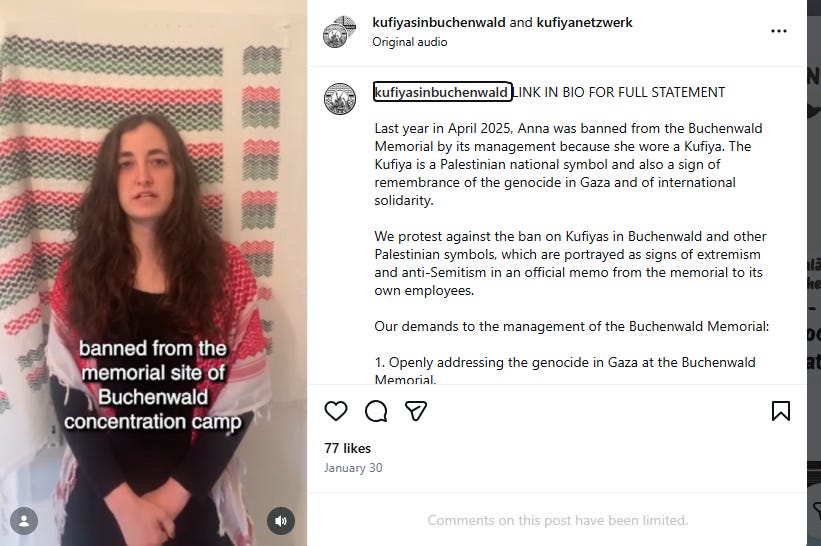
The “Kufiyas in Buchenwald” group’s statement accused the memorial of “historical revisionism and genocide denial,” claiming it has become a venue for “Israeli propaganda.” Their published demands include:
“Openly addressing the genocide in Gaza” at the memorial
Lifting bans on Palestinian symbols including the keffiyeh
Eliminating entry or speaking restrictions based on pro-Palestinian activism
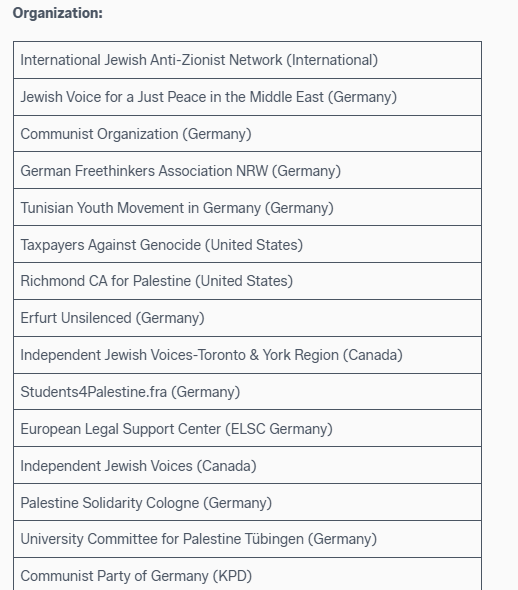
Part of Signature List of “Kufiyas in Buchenwald” Demands. Credit: Kufiyas in Buchenwald
Official Condemnation
German officials have responded with alarm to the planned demonstrations. Felix Klein, Germany’s Federal Commissioner for Combating Antisemitism, called the protest “new low point in the unfortunately all-too-common reversal of perpetrator and victim roles,” adding: “I strongly condemn this frontal attack on the dignity of the memory of the victims of the Holocaust.”
Bodo Ramelow, former Thuringia Minister-President and current Bundestag member for the Left Party, distanced his party from the extremist organizers, describing the campaign as coming from a “highly unpleasant, neo-Stalinist organization” and stating: “We are witnessing an attempt to hijack commemoration.”
A spokesperson for the Buchenwald memorial told the Swiss newspaper Neue Zürcher Zeitung that officials are “concerned about attempts to misuse the memorial site,” though concrete details about the protest plans remain unknown to memorial leadership.


Historical Significance Under Threat
Buchenwald holds particular significance in Holocaust memory as prisoners organized internal resistance and liberated themselves on April 11, 1945, shortly before U.S. forces arrived. The camp’s survivors issued the Buchenwald Oath, vowing to destroy Nazism “at its roots” and build “a world of peace and freedom.”
The memorial has faced attacks from both far-right extremists seeking to minimize German responsibility for the Holocaust and now, increasingly, from far-left groups attempting to appropriate Holocaust memory for anti-Israel political activism—a convergence that German security officials view with growing concern as the April commemoration approaches.
The ‘Palestinian Cause’ has pretty much appropriated every other struggle in the world…EXCEPT those mass murders perpetrated by Arabs and other Muslims - in the MILLIONS - against each other as well as racially motivated, as Arab Sudanese murder Black Sudanese and cause starvation of 25,000,000!!! Then there are the Arabian kingdoms STILL taking Black Africans as SLAVES. But let’s not mention these. To progressives, ‘Black African Lives Don’t Matter.’
shalom / salaam
How many Israelis were murdered in Buchenwald?