


A new report commissioned by the European Conservatives and Reformists (ECR) Group in the European Parliament reveals the extensive infiltration of Muslim Brotherhood-affiliated organizations into EU funding mechanisms and policy-making structures, raising urgent questions about oversight and the protection of European democratic values.
The 50-page report, titled “Unmasking the Muslim Brotherhood: Brotherism, Islamophobia & the EU,” was authored by Dr. Florence Bergeaud-Blackler, a Senior Researcher at France’s Centre National de la Recherche Scientifique, alongside Dr. Tommaso Virgili, a Visiting Researcher at Berlin’s WZB Social Science Center.
€23 Million in EU Funding Identified
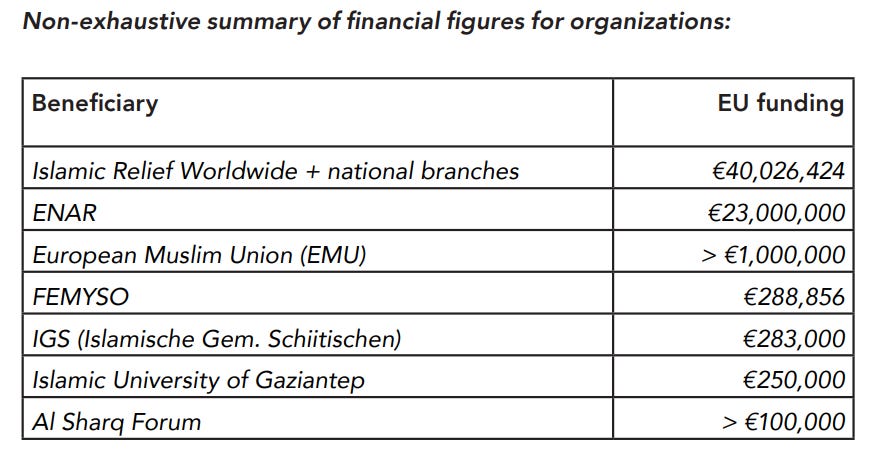
The investigation documents how organizations linked to the Muslim Brotherhood have received significant European Union funding despite connections to extremist ideology. According to parliamentary records cited in the report, the European Network Against Racism (ENAR) alone received approximately €23 million in EU funding between 2007 and 2020. ENAR was headed from 2010 to 2021 by Michaël Privot, a former sworn member of the Muslim Brotherhood who later publicly renounced his affiliation.
“The European Commission does not finance extremists,” EU Commissioner for the European Way of Life Margaritis Schinas declared in 2019 when confronted by ECR MEP Charlie Weimers about Islamist funding. The new report directly challenges that assertion with documented evidence of systematic financial and institutional support flowing to Brotherhood-affiliated networks.
“Brotherism”: A Strategic Ideology of Gradual Infiltration
The report discusses the concept of “Brotherism” — a sophisticated strategy of societal transformation that operates through legitimate-appearing civil society organizations while pursuing a long-term agenda of implementing Islamic law. Unlike violent extremist groups, the European Muslim Brotherhood employs “entryism” — a patient strategy of infiltrating institutions, building networks, and gradually shifting societal norms.
“The Brotherhood is a wolf-in-sheep’s-clothing,” writes Swedish MEP Charlie Weimers in the report’s foreword. “They pose as reformists, eager to work within existing systems and engage with governments and society. But we must not be fooled—this tactical pivot is not a change of heart.”
Key Organizations Under Scrutiny
The report identifies six main pan-European structures with Muslim Brotherhood connections:
Council of European Muslims (CEM), formerly known as the Federation of Islamic Organizations in Europe (FIOE), serves as an umbrella organization bringing together main national entities associated with the Muslim Brotherhood
Forum of European Muslim Youth and Student Organizations (FEMYSO), a Brussels-based network where leadership positions are often held by children of senior Brotherhood members
European Institute of Human Sciences (IESH) — a network of schools in France, Germany, the UK and Finland whose French branch was dissolved by authorities in September 2025 for promoting violent jihad, inciting discrimination and hatred, and propagating extremist ideologies
European Council for Fatwa and Research (ECFR), based in Dublin and established by al-Qaradawi to provide religious rulings helping European Muslims reconcile Islamic law with life in non-Muslim-majority societies
Europe Trust, headquartered in the UK and engaging in financial activities, primarily real estate investments, to fund network initiatives
Islamic Relief Worldwide (IRW) and its local branches, which despite denying affiliation have extensive organizational and personal connections to the Brotherhood’s European network
Beyond these core organizations, the authors document numerous national, regional, and local entities connected through overlapping leadership, shared ideology, familial ties, and organizational collaborations, the report contends.
The “Islamophobia” Weapon
A substantial portion of the report examines how Brotherhood-affiliated organizations have weaponized the concept of “Islamophobia” to frame legitimate criticism of Islamist ideology as racism. This rhetorical strategy has proven remarkably effective at securing funding and institutional legitimacy, according to the report, while allowing these groups to align with left-wing political movements focused on “intersectional” and “critical race” ideologies.
ENAR has coordinated a “European Coalition Against Islamophobia” that the report describes as a “network of Brotherist influencers” comprising key Brotherhood-linked organizations including FEMYSO, the European Forum of Muslim Women (EFOMW), the Collective against Islamophobia in Europe (CCIE), and the Muslim Council of Britain (MCB).
The report notes that ENAR has successfully influenced documents from the European Commission, European Parliament, and the EU’s Fundamental Rights Agency. In 2023, the Fundamental Rights Agency shared on social media a call for a “march against Islamophobia” promoted by ENAR and other Brotherhood-linked organizations.
Systemic Oversight Failures
The report identifies critical flaws in EU funding oversight mechanisms that have allowed Brotherhood-affiliated groups to exploit the system. Current monitoring focuses on financial fraud and procedural compliance rather than ideological content. Officials rely on proper paperwork and an organization’s ability to parrot project goals, creating vulnerabilities that sophisticated actors can exploit.
“The administrative state….runs on impersonal principles like the rule of law and impartial decision-making.,” Weimers writes. “But the system rests on shaky assumptions. It presupposes officials understand the Brotherhood’s true nature, which they often don’t. It also assumes financial fraud is the main threat, so it’s geared toward scrutinizing applications, receipts, accounts and ensuring that activities have happened. The actual content—what’s said in a funded meeting or lecture; what is actually being propagated—slips through the cracks.”
Political directives often prioritize funding minority-run organizations without adequate vetting, while fear of being accused of “Islamophobia” creates a chilling effect that prevents officials from challenging problematic organizations. “Any official who dares push back risks accusations of racism or ‘Islamophobia’—a chilling effect that will prevent most officials from acting unless they are extraordinarily principled and courageous,” the report states.
Urgent Calls for Reform
The report concludes with urgent calls for enhanced due diligence in vetting funding recipients, implementation of successful counter-infiltration measures from France and Austria across the EU, lower thresholds for excluding organizations with extremist ties, improved monitoring of ideological content rather than merely procedural compliance, and greater transparency in EU funding allocation.
“This report lays bare a troubling pattern: Brotherhood-affiliated organizations routinely pursue goals and activities that run counter to European values—democracy, the rule of law, individual liberty, gender equality, and respect for diverse faiths,” Weimers concludes. “These aren’t outliers; they reflect the Brotherhood’s core ideology. The conclusion is inescapable: European institutions, member states, and regional authorities must cut all ties, funding, and legitimacy to these groups. Anything less is a betrayal of the future of Europe and our shared values.”