


Jewish Onliner is an independent publication. If you find our work valuable, please consider becoming a paid subscriber.
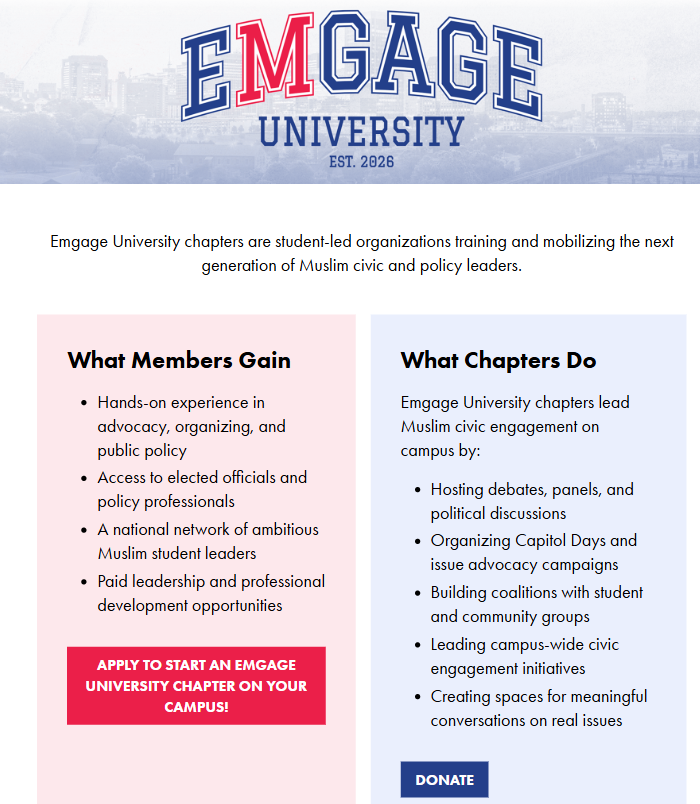
Emgage, one of the most influential Muslim political advocacy organizations in the United States, is launching a new initiative aimed at organizing Muslim students through twelve student-led chapters across the country. Branded as “Emgage University,” the effort appears designed to build a new pipeline of student activists and political organizers at a moment when universities have become central battlegrounds over Israel, antisemitism, and Middle East politics.
Emgage has also faced scrutiny over its partnerships with CAIR and the Islamic Society of North America (ISNA), both named in government filings as unindicted co-conspirators in the Holy Land Foundation terror-financing case. Emgage has also cohosted ISNA conferences, even as ISNA has faced longstanding scrutiny over alleged historical links to the Muslim Brotherhood network.
The group has also drawn scrutiny over its funding. The Washington Free Beacon reported that Emgage Action, Emgage’s 501(c)(4) advocacy arm, received $1 million in organizational support from the Open Society Policy Center, part of George Soros’s Open Society network, in late 2019.
The organization, originally founded in 2006 as the “Center for Voter Advocacy,” later rebranded to “Emerge USA PAC” before adopting the name Emgage in 2017. According to organizational materials, Emgage now maintains chapters across California, Florida, Michigan, New York, Pennsylvania, Texas, and Virginia, alongside a national office in Washington, D.C.
Over the past several election cycles, Emgage has positioned itself as a major force in Muslim political mobilization. Its “Million Muslim Votes” campaign sought to mobilize Muslim voters in key swing states ahead of the 2020 election, with former President Joe Biden remotely addressing one of the group’s summits. The organization later announced plans to expand the effort ahead of the 2024 election cycle, with the stated goal of surpassing its 2020 turnout numbers. Now, Emgage University appears poised to bring that organizing model directly onto American campuses.
Partnerships With CAIR and ISNA
Emgage’s partnerships with CAIR and the Islamic Society of North America (ISNA) have fueled scrutiny of its place within a broader Muslim civic and advocacy network that includes organizations facing allegations over historical Brotherhood or Hamas-linked ties.
Emgage’s own 2024 Million Muslim Votes announcement listed ISNA as a national partner, while the campaign’s public partner page included CAIR-Philadelphia among partner logos.


Emgage also worked with ISNA and the Muslim Public Affairs Council at the 2019 ISNA convention, where the groups hosted a presidential forum featuring Bernie Sanders and Julián Castro. Separately, CAIR-Philadelphia and Emgage Pennsylvania have co-hosted Muslim civic-engagement events, including Muslim City Hall Day in Philadelphia and Muslim Capitol Day in Harrisburg.

Several senior Emgage figures have held positions or maintain ties to those organizations. Khurrum Wahid, the co-founder and chairman of Emgage Action and Emgage PAC, previously served as a legal advisor to CAIR and as an officer in CAIR-Florida, according to the report.
Emgage board chair Iltefat Hamzavi has served on the boards of ISNA and The Muslim Observer, according to Emgage’s own biography. The Washington Examiner reported that The Muslim Observer had published articles accusing Israel of controlling major aspects of American politics, government, the economy, and media.
Nadia Hassan, Emgage’s Senior Advisor and Political Director for Southern California, previously worked as a program coordinator at ISNA.
October 7, Campus Activism, and Antisemitism Concerns
Emgage Action issued a statement days after the massacre arguing that the “root causes” of the conflict which include “occupation” and Israel’s blockade of Gaza, must be addressed.
The organization later endorsed “Ceasefire Now” resolutions promoted by progressive lawmakers including Reps. Rashida Tlaib and Summer Lee, while also circulating campaigns opposing additional U.S. aid to Israel under the hashtag “#NoBlankChecksforNetanyahu.” Emgage also defended pro-Palestinian campus protesters and opposed the Antisemitism Awareness Act after nationwide university encampments erupted in 2024.

Farrukh Shamsi, Emgage Texas State Board Chair, posted an image of the White House labeled “AIPAC House,” implying that Israel or pro-Israel lobbying interests control the White House.
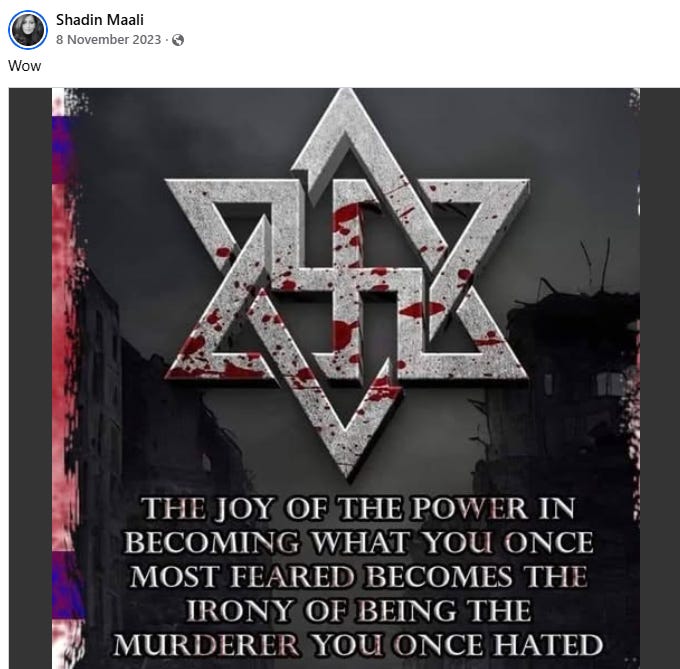
Shadin Maali, Emgage’s Senior Director for Growth and Operations, circulated imagery depicting a swastika inside a blood-covered Star of David. Furthermore, on Oct. 8, 2023, one day after Hamas’ Oct. 7 massacre, she wrote on X that it was ‘time to address the deep-rooted causes of Palestinian resistance against longstanding injustices,’ framing the terror attack within a broader political grievance narrative.


Emgage’s Ties to the Democratic Establishment
At the same time, Emgage has cultivated extensive ties inside the Democratic Party and the executive branch.
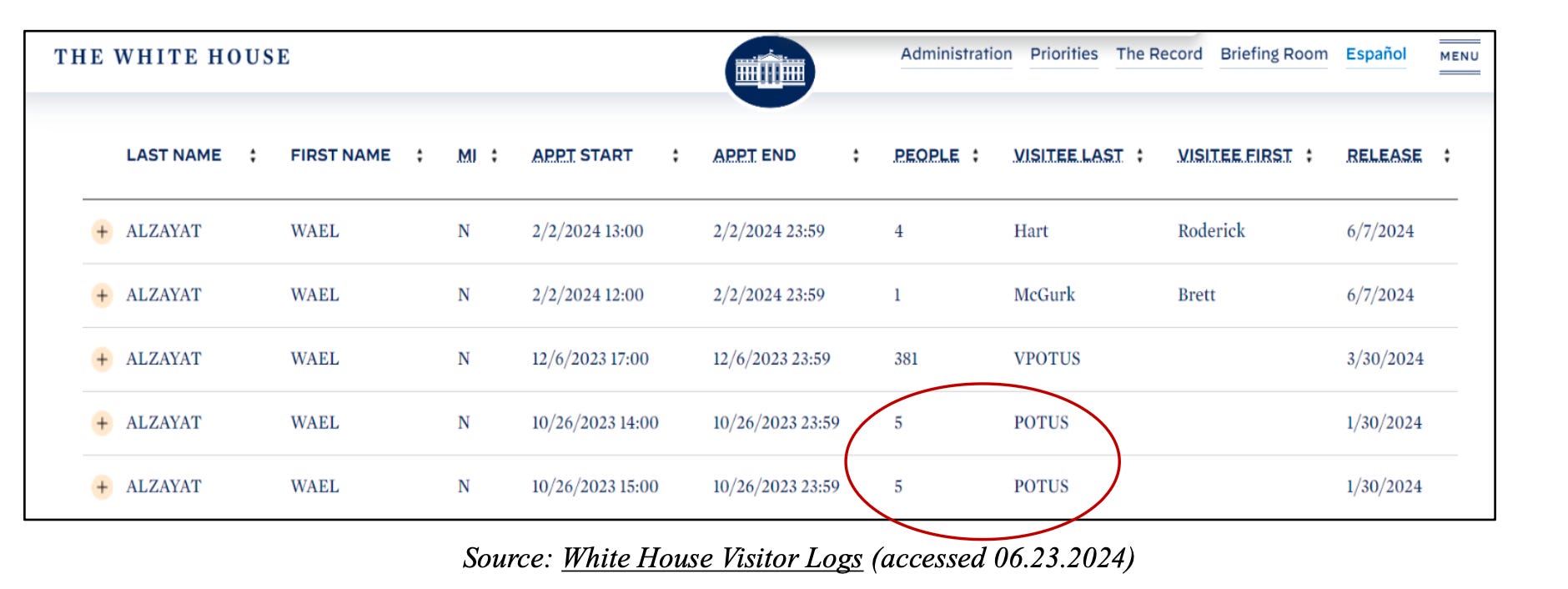
White House visitor logs reviewed by Jewish Onliner indicate that Wa’el Alzayat, Emgage’s former CEO and current principal advisor, attended 27 White House meetings between 2021 and mid-2024. Those included several meetings after Hamas’ October 7 attacks and at least two smaller sessions that included then-President Biden. The organization also reportedly held monthly meetings with the White House Presidential Personnel Office, underscoring Emgage’s access inside the former Biden administration.
Several current and former figures connected to Emgage and Emgage Action have held Democratic campaign or government roles, including positions tied to Hillary Clinton’s 2016 campaign, the Biden-Harris campaign, the Biden administration, the Pentagon, USAID, and the Small Business Administration.
A Campus Test for Emgage
The launch of Emgage University suggests Emgage is moving beyond election-cycle mobilization and investing in a longer-term pipeline for young Muslim political activists on American campuses.
For now, the initiative is being presented as a civic-engagement and leadership-development program. But its arrival comes at a volatile moment for universities, where debates over Israel, antisemitism, Gaza, and Middle East policy have become defining campus flashpoints. That context is likely to bring added scrutiny to Emgage’s campus expansion, particularly given its partnerships with Brotherhood-scrutinized organizations, its access to Democratic power centers, and the controversial public record of figures within its broader leadership network.