


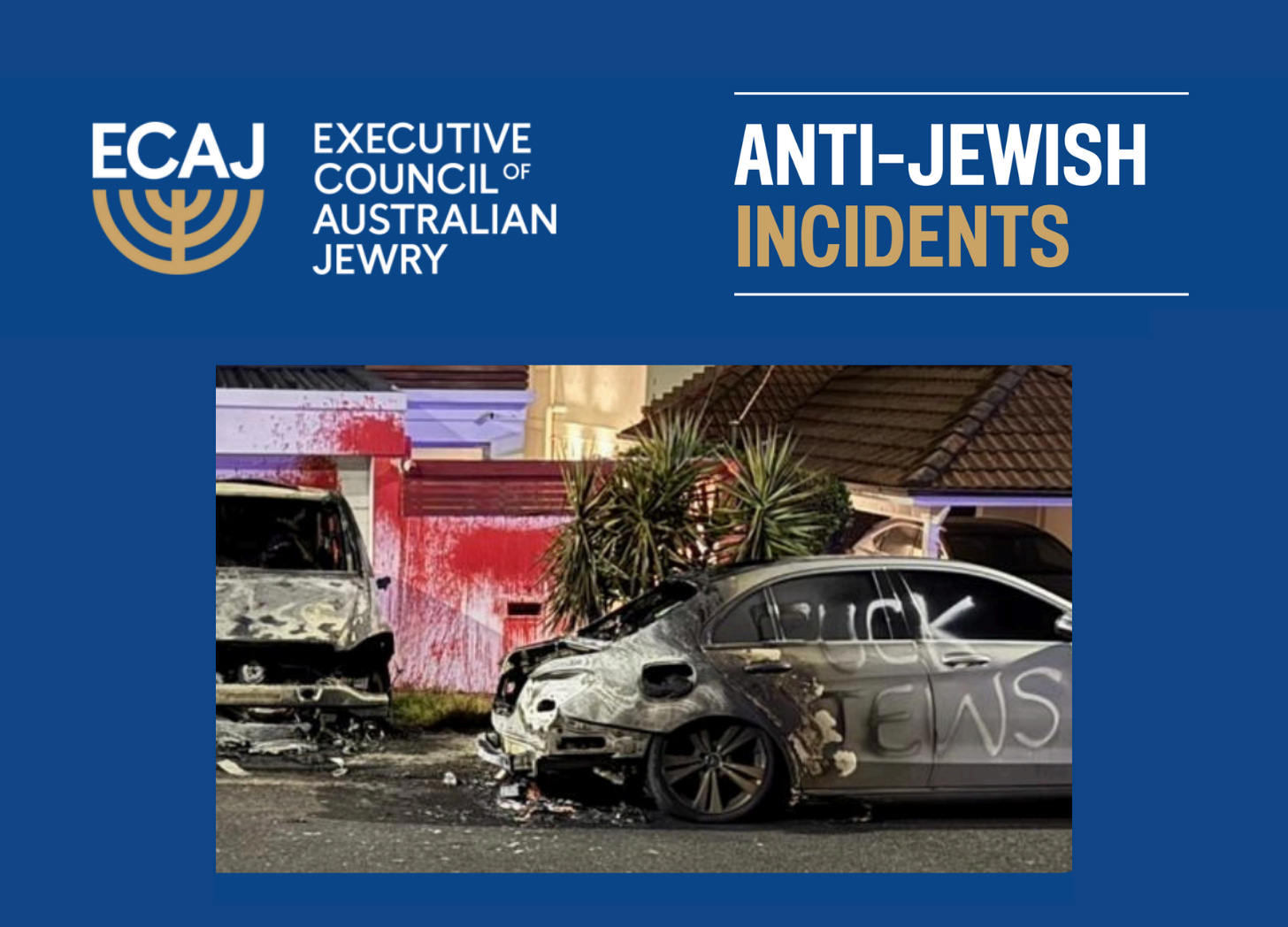
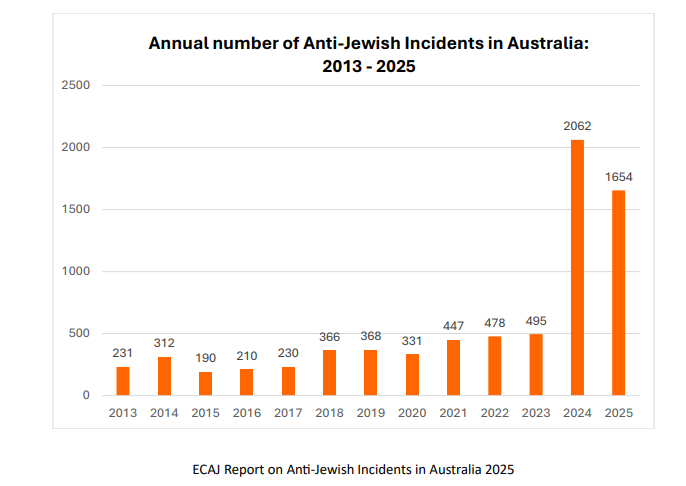
A comprehensive new report released by the Executive Council of Australian Jewry (ECAJ) documents 1,654 antisemitic incidents across Australia between October 2024 and September 2025, maintaining levels approximately three times higher than any year prior to October 2023.
The data reveals a particularly disturbing trend: while total incidents decreased slightly from the previous year’s record of 2,062, attacks involving arson and vandalism—the most dangerous forms of anti-Jewish violence—actually increased.
The twelve-month period witnessed eighteen major antisemitic incidents between October 2024 and February 2025 alone, including some of the most severe attacks in Australian history. These included the firebombing of a kosher catering business in Bondi and the complete destruction of Melbourne’s Adass Israel Synagogue in an arson attack later declared an act of terrorism.
Foreign Terror and Domestic Threats Converge
Australian authorities and ASIO confirmed in August 2025 that Iran’s Islamic Revolutionary Guard Corps (IRGC) orchestrated major arson attacks targeting Jewish institutions and businesses. This foreign terrorist involvement represents a dramatic escalation in the threats facing Australia’s Jewish community.
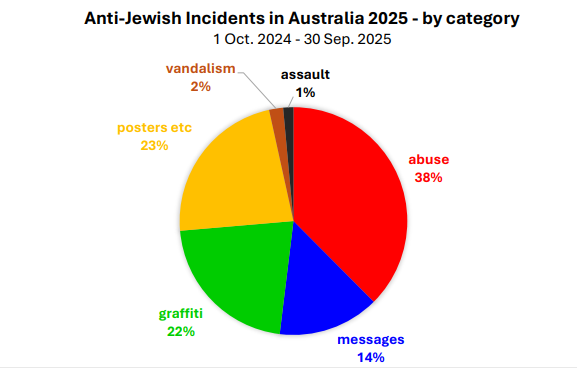
The ECAJ report documented 621 cases of verbal abuse, 359 graffiti incidents, 379 instances of antisemitic posters and stickers, 238 threatening messages, 33 vandalism attacks, and 24 physical assaults. New South Wales recorded the highest number of incidents with 738, followed by Victoria with 662, Western Australia with 108, and Queensland with 50.
Mainstreaming of Anti-Jewish Hatred
The report’s authors emphasize that antisemitism has undergone a fundamental shift in Australian society. “We are now at a stage where anti-Jewish racism has left the fringes of society and become part of the mainstream, where it is normalized and allowed to fester and spread,” the report states, noting the phenomenon’s spread into universities, workplaces, healthcare facilities, and cultural institutions.
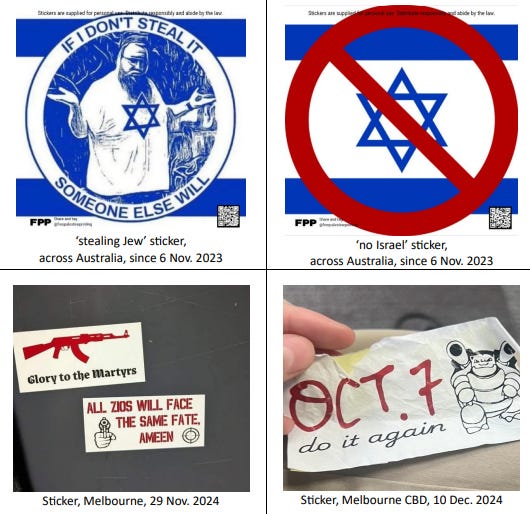
Researchers identified an unprecedented convergence of extremist ideologies, with neo-Nazis, far-right groups, far-left activists, and Islamist organizations increasingly cooperating in their targeting of Jewish Australians. This cross-ideological alliance marks a dangerous new phase in organized antisemitism.
Escalating Violence and Direct Threats
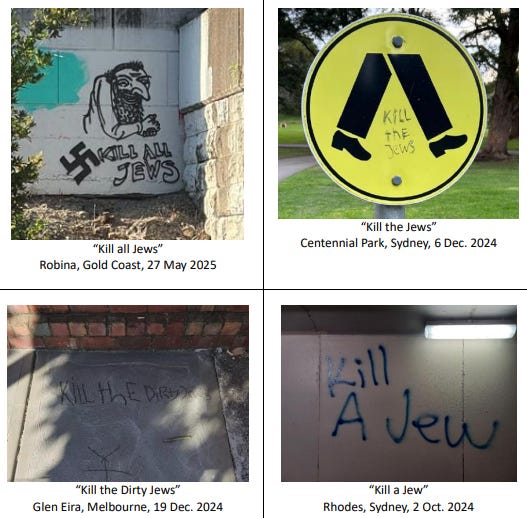
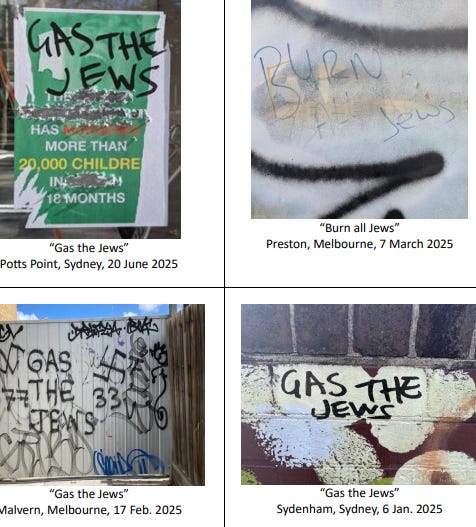
Beyond the raw statistics, the report highlights a qualitative shift in antisemitic expression. Graffiti explicitly calling for the killing of Jews appeared with increasing frequency, employing Nazi-style rhetoric and symbolism in public spaces. Multiple vehicles were set ablaze and defaced with antisemitic slogans, while synagogues faced repeated vandalism and threats.
The data covers only incidents reported to volunteer Community Security Groups, official Jewish organizations, and the ECAJ itself, meaning the actual number of antisemitic incidents likely exceeds the documented total. Social media antisemitism was excluded unless it constituted a specific, credible threat.
Community Safety Concerns Mount
Jewish Australians now face what the report describes as “legitimate concerns for their physical safety and future in Australia.” The average annual incident count before October 2023 stood at 342 over the preceding decade. Since the Hamas terrorist attacks of October 7, 2023, that average has surged to 1,858 incidents per year—more than a fivefold increase.
The ECAJ emphasizes that while law enforcement has taken important steps, including proscribing the IRGC as a terrorist organization, addressing the normalization of antisemitism in mainstream Australian society requires action beyond criminal justice measures. The report calls for urgent efforts to combat anti-Jewish hatred in academic, cultural, and political spheres, and stresses the need for continued community vigilance and government partnership.
As Australia grapples with this crisis, the Jewish community faces an environment where hostility once confined to extremist margins has gained disturbing acceptance in everyday Australian life.