


Jewish Onliner is an independent publication. If you find our work valuable, please consider becoming a paid subscriber. You can also subscribe to us on WhatsApp and Telegram. Follow us on Instagram, Discord, and X.
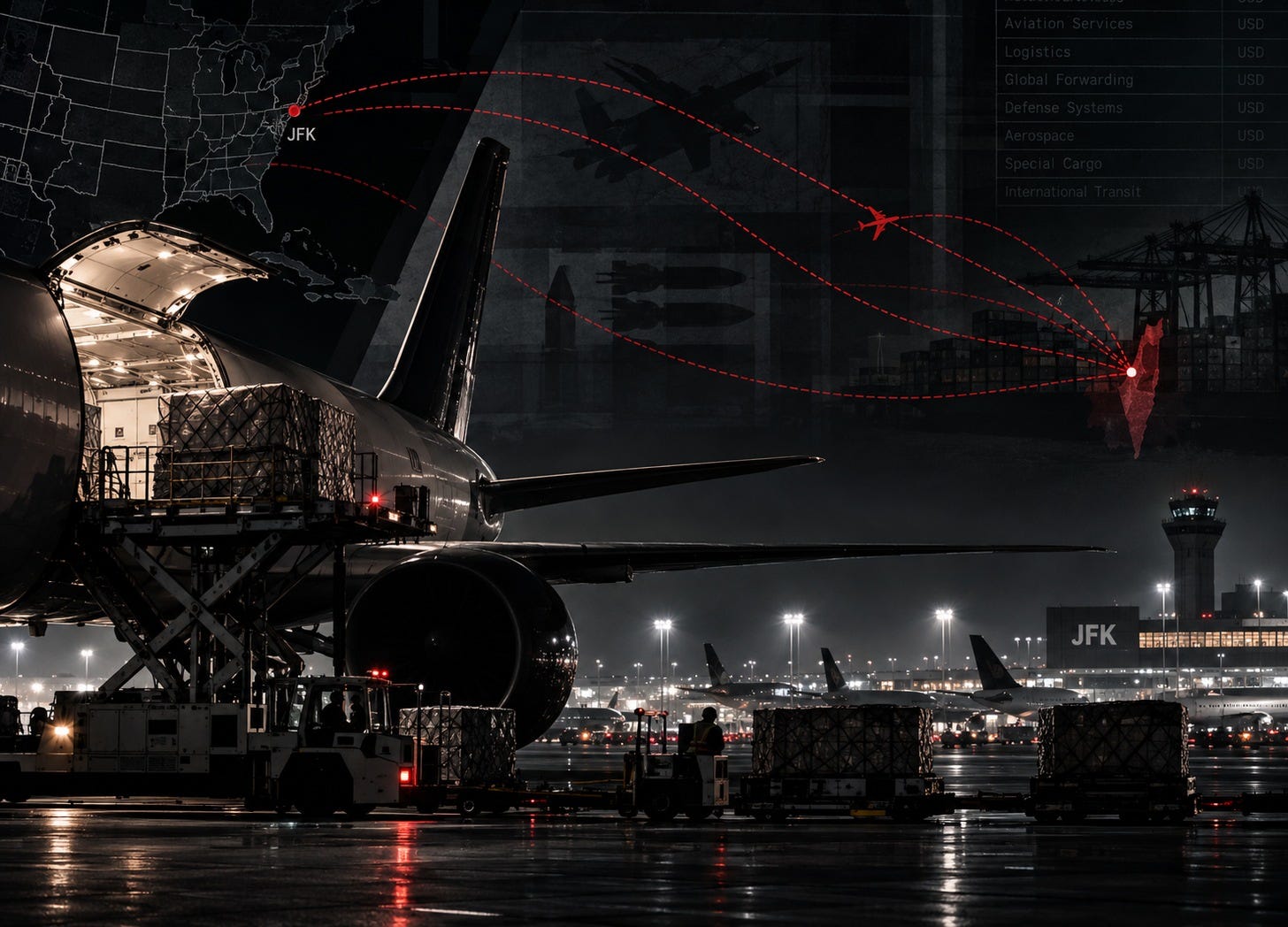
The New York City chapter of the Democratic Socialists of America (NYC-DSA) is organizing a mass meeting on October 17 to expand a campaign recruiting airport workers and labor unions to halt weapons shipments to Israel through John F. Kennedy International Airport, targeting a critical transportation hub for American defense exports.
The gathering, scheduled for 2 p.m. at the Fifteenth Street Friends Meeting House in Manhattan, is organized by Break the Chain alongside NYC-DSA’s Labor and Anti-War working groups. Participating organizations will be asked to formally endorse the campaign, join airport leafleting activities, and recruit workers into organizing circles.
The initiative goes beyond demonstrations calling for an American arms embargo. Its organizers are seeking to enlist employees involved in transporting military equipment to refuse shipments themselves, while building political pressure against the companies responsible for moving weapons and defense technology to Israel.
Break the Chain has already developed a database identifying 39 companies involved in regional defense manufacturing and cargo transportation, secured support from labor organizations, and established relationships with New York political figures.
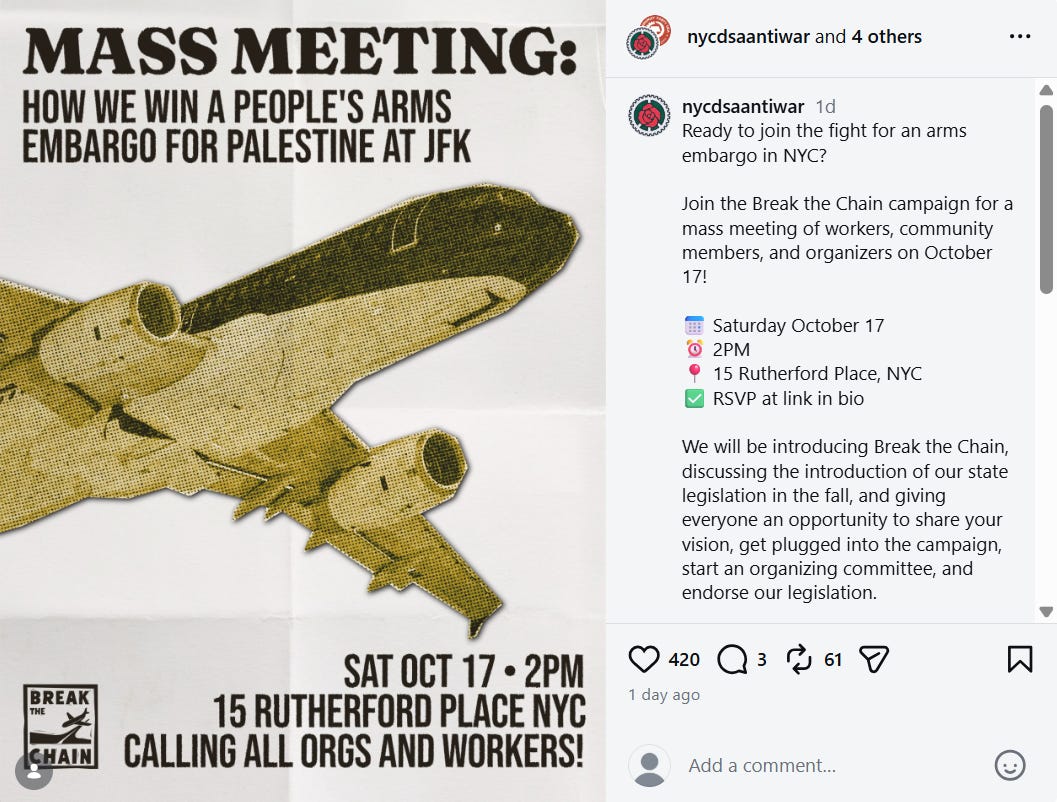
From Socialist Organizing to an Airport Campaign
Break the Chain was established in June 2025 by NYC-DSA’s Anti-War Working Group, following research by the Palestinian Youth Movement (PYM) documenting the movement of military cargo through New York-area transportation facilities.
The initiative is part of DSA’s national Labor for an Arms Embargo campaign, which launched in May 2025 and aligned itself with PYM’s Mask Off Maersk initiative and Progressive International’s No Harbor for Genocide campaign.
The connection between DSA and PYM extends to joint research and organizing strategy. In August 2025, DSA’s Democratic Left published an article coauthored by PYM organizers Kaleem Hawa and Lea Kayali alongside Abdullah Farooq, a founding member of DSA’s national arms-embargo campaign.
In September 2026, DSA, PYM, People’s Embargo for Palestine, and the Movement Research Unit jointly reported identifying 2,761 shipments to Israeli defense manufacturers aboard United Airlines passenger flights between July 2025 and February 2026, primarily through Newark Liberty International Airport. Researchers examined the contents of a sample of 546 shipments.
The campaign’s ambitions extend well beyond stopping the export of rifles or ammunition.
In a September 10 article for DSA’s Socialist Forum, organizer Sammy Z described the objective as ending all military trade with Israel, including not only weapons and aircraft components but also intelligence, research, software, and technical knowledge.
Sammy argued that workers could accomplish what political campaigns directed at Congress have failed to achieve, describing how cargo handlers, pilots, truck drivers, and mechanics could collectively refuse to facilitate military deliveries.
The position directly challenges the longstanding American defense partnership with Israel. Under a 2016 agreement, the United States committed $38 billion in security assistance over ten years, including funding for missile-defense cooperation. Break the Chain seeks to interrupt the transportation networks supporting that relationship, regardless of whether Washington formally adopts an embargo.
Recruiting Workers to Refuse Military Cargo
A detailed organizing toolkit published by Break the Chain outlines the campaign’s workplace strategy.
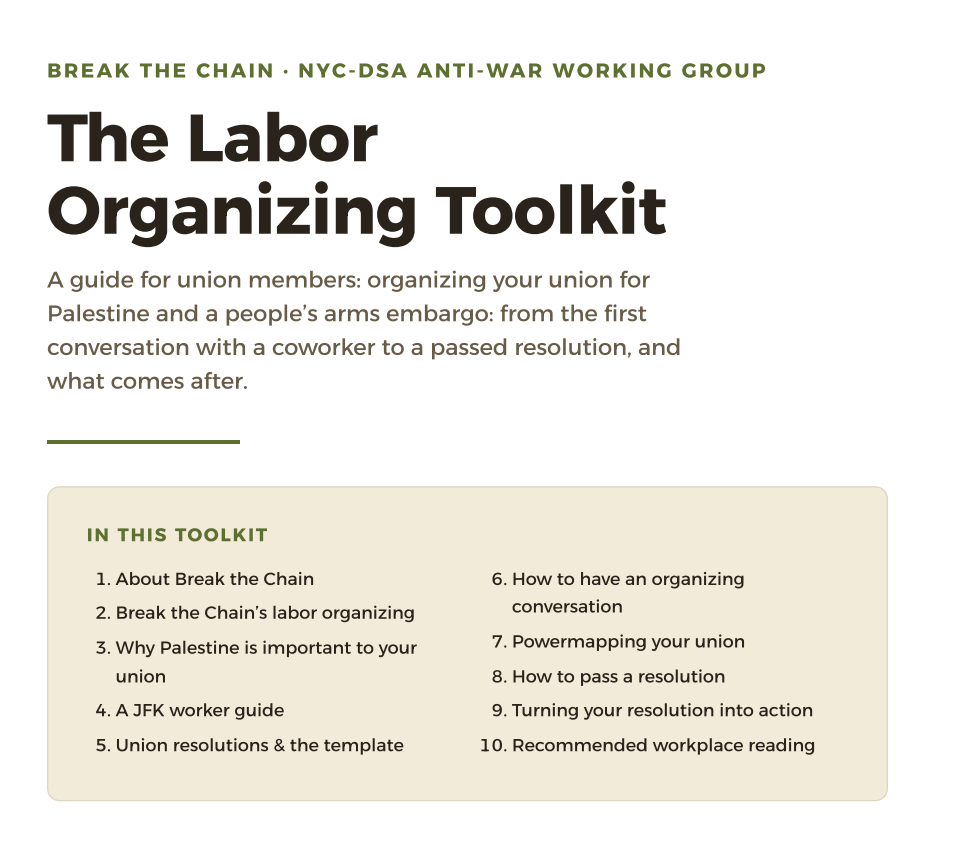
The document calls on supporters to recruit coworkers, establish workplace committees, map union leadership structures, circulate petitions, and pass resolutions supporting the refusal to manufacture or transport military equipment to Israel.
Its airport-specific guide addresses cargo handlers, flight attendants, ticket agents, maintenance employees, and other aviation workers. It also provides a petition template collecting workers’ names, contact information, employers, airport locations, and departments.
The toolkit proposes that participating union locals each appoint two representatives to a Break the Chain Union Organizing Committee, responsible for coordinating with other unions and organizing efforts supporting the refusal of military cargo.
The document even imagines air traffic controllers preventing explosives from reaching runways and cargo handlers refusing to load shipments.
In September, Break the Chain organizer Bassel Al-Khalili told The Indypendent that activists had distributed materials to airport workers every Sunday for much of the preceding year and were working closely with dozens of JFK employees.
The campaign’s endorsement page lists 16 labor, community, and activist organizations that have formally endorsed its objectives or adopted relevant resolutions.
Among them are Labor for Palestine, UAW Labor for Palestine, CWA for Palestine, No Tech for Apartheid, Desis Rising Up & Moving (DRUM), Jewish Voice for Peace–NYC, AROC Action, NYC Educators for Palestine, and CUNY Faculty and Staff for Justice in Palestine.
Three United Auto Workers locals have adopted arms-embargo resolutions: the Association of Legal Aid Attorneys, UAW Local 2325; the National Organization of Legal Services Workers, UAW Local 2320; and Student Workers of Columbia, UAW Local 2710.
CWA for Palestine, a rank-and-file network that includes aviation workers, has also condemned United Airlines’ transportation of military equipment to Israel.
Mapping the Supply Chain
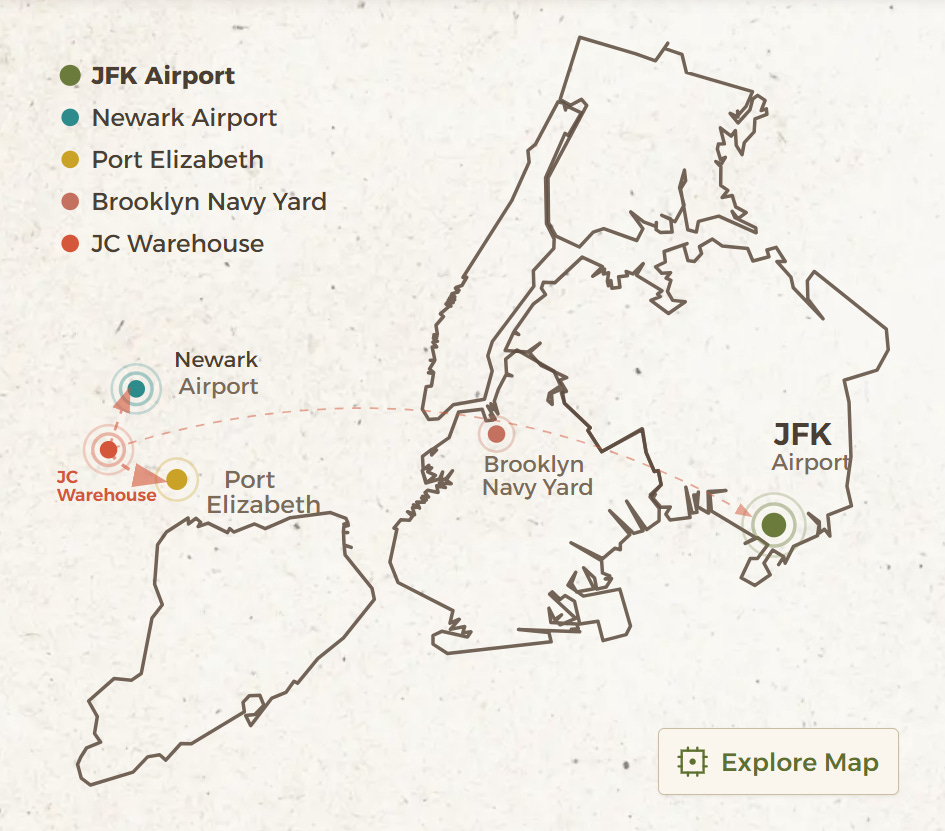
Break the Chain has assembled a publicly accessible database of 39 companies with documented roles in defense manufacturing or the transportation of military equipment across the New York–New Jersey region.
Eight entries are associated with JFK Airport. Companies identified include Challenge Airlines, Kalitta Air, Delta Air Lines, FedEx, DHL Global Forwarding, JAS Forwarding, Elbit Systems, and IMI Systems.
The database draws on investigative reporting, government contracts, shipping records, and corporate disclosures. It encompasses airlines and freight forwarders alongside manufacturers producing military equipment and components.
The campaign’s demands call on workers to refuse to manufacture or transport weapons and dual-use technology destined for Israel, halt relevant military trade and production, and boycott companies involved in the defense industry.
Its demands also extend to military manufacturing at facilities such as the Brooklyn Navy Yard, bringing the campaign into industries beyond commercial aviation.
Political Support and Pressure on New York Airlines
The campaign has also developed connections with elected officials and Democratic candidates seeking to influence state transportation policy.
On September 23, NYC-DSA announced a press conference at JFK listing State Senator Jabari Brisport, State Senate nominee Aber Kawas, and State Assembly nominee David Orkin alongside DRUM, Jewish Voice for Peace, Rockaway for Palestine, and Common Defense.
According to a September 4 report, Brisport has been building support for a proposed initiative called Not in Our Skies, which would use airline subsidies to pressure carriers and the Port Authority of New York and New Jersey to restrict shipments of military equipment.
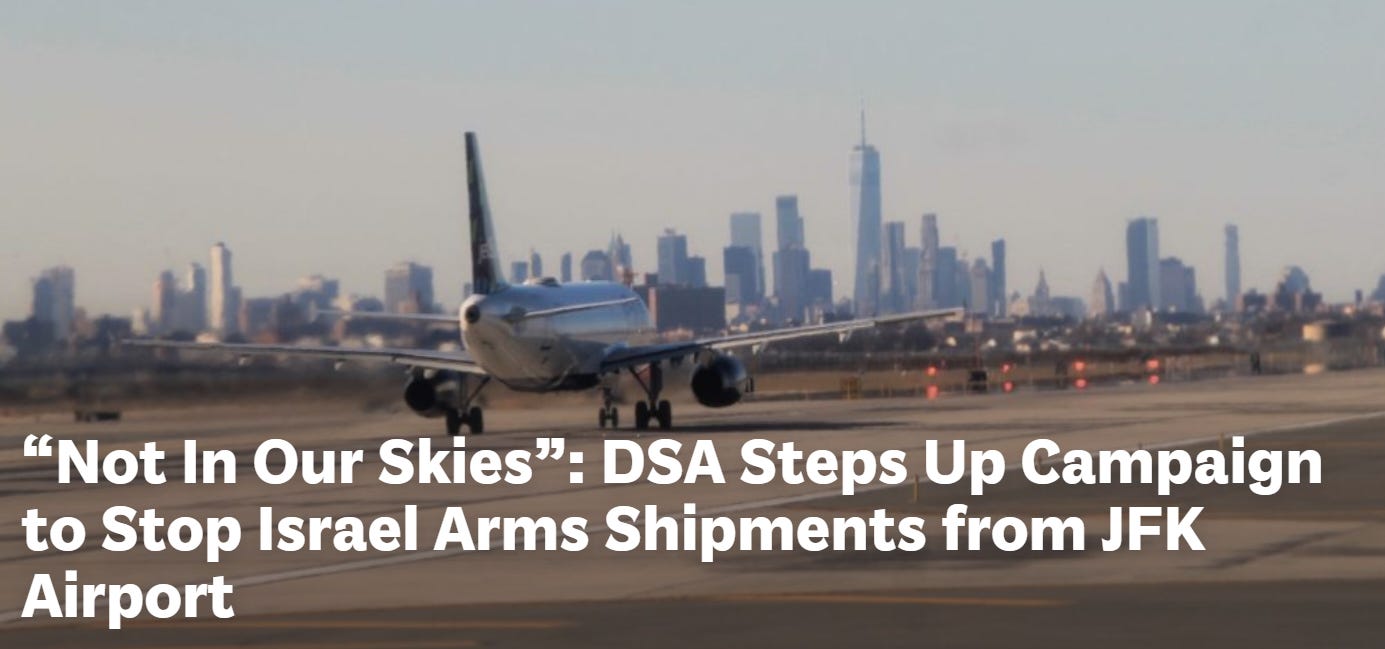
Break the Chain campaign chair Ethan Eblaghie described the proposal as a means of leveraging state policy to pressure the airlines and the Port Authority.
Kawas publicly endorsed the campaign in a September 24 opinion article for City & State New York, urging state officials to intervene in military transportation through New York’s airports.
The political activity follows Break the Chain’s elevation to priority-campaign status within NYC-DSA in July, after receiving approximately 90 percent support in a chapter vote, according to The Indypendent. That designation gave the initiative representation on the chapter’s Socialists in Office Committee, which coordinates relationships with elected officials.
The October 17 meeting will bring together the campaign’s labor and activist partners to expand an effort aimed at stopping American military exports to Israel through worker-led refusals, corporate pressure, and state-level political intervention.
Its organizers are seeking more than a symbolic boycott. They are attempting to build a coalition capable of interfering with the movement of defense equipment and technology through one of America’s busiest international airports, using workers themselves to accomplish an embargo that the federal government has not enacted.
They sure are lucky that we don't do suicide bombings. Because that would be a hell of a target.