


A comprehensive 85-page investigation released in October 2025 has unveiled what experts describe as a systematic campaign by the Islamic Republic of Iran to infiltrate French society through espionage networks, political influence operations, and criminal proxies.
The report, commissioned by the France 2050 think tank and led by Gilles Platret, mayor of Chalon-sur-Saône, was submitted to the French Senate, National Assembly, and Interior Ministry, documenting what investigators call a “mechanics of chaos” designed to destabilize Western democracies.
The investigation reveals how Tehran has built ideological and operational networks across France’s political landscape, universities, media outlets, and criminal underworld over forty-eight years, with Jewish communities and pro-Israel voices among the primary targets of what the report calls Iran’s “mechanics of chaos.”
Constitutional Mandate for Global Jihad
What distinguishes Iran’s infiltration strategy from typical foreign influence operations is its constitutional foundation. The report emphasizes that Articles 5, 11, and 150, along with the preamble of Iran’s 1979 constitution, explicitly mandate the export of Islamic revolution and pursuit of “global jihad.” The Islamic Revolutionary Guard Corps was created as an “ideological army” charged with serving Shiite Islamist ideology both inside and outside the country.
“This strategy has been conceived, planned, and constitutionalized,” Platret writes in his introduction. “Infiltration has acted as a poison, slowly seeping into French society for nearly fifty years; drop by drop, it spreads, exerts influence, and corrodes.”
Frédéric Encel, a geopolitics expert and Middle East specialist who contributed to the report, explains that Iran’s expansionist ideology remains constant regardless of internal political changes. “Shiite expansionism will always be the regime’s guiding principle, as is the regime’s intrinsic violence,” Encel states, noting that Tehran’s strategy relies on propaganda, infiltration, and physical elimination.
Embassy Operations and Campus Recruitment
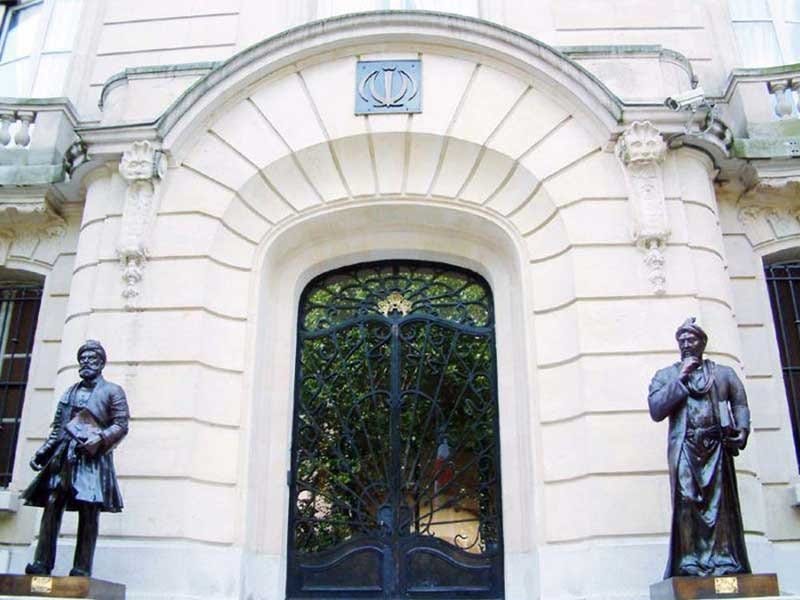
The investigation reveals that Iran’s Paris embassy has served as a coordination hub for influence operations. In February 2025, embassy officials organized recruitment sessions with student representatives from twelve prestigious French universities and grandes écoles, conducting what investigators describe as ideological “castings” to identify potential assets.
The report reveals that Iranian embassy officials conduct systematic outreach to French intellectuals, journalists, academics, and students. The second-ranking diplomat typically handles overt relationship-building, hosting lunches at Persian restaurants and connecting with left-leaning intellectuals receptive to Tehran’s messaging.
Meanwhile, covert operatives work under cultural or economic cover to identify and recruit potential assets, often conducting meetings in neighboring countries like Germany or Spain to evade French counterintelligence detection.
The report outlines Iran’s strict ideological criteria for recruitment targets: anti-imperialism, anti-colonialism, anti-Israel sentiment, dedication to the Palestinian cause, and anti-Western ideology. Iranian operatives have systematically targeted French campuses since the 1980s through the Association of Iranian Muslim Students in France, which built connections with French student unions and provided subsidized trips to Tehran along with scholarships through Iran’s Paris cultural center.
Espionage Operations on French Soil
Beyond diplomatic cover, the investigation documents active espionage operations conducted by the Quds Force, the elite external operations unit of the Islamic Revolutionary Guard Corps. In spring 2024, French authorities arrested Bashir Biazar, a high-level agent of the Quds Force, the elite external operations unit of Iran’s Islamic Revolutionary Guard Corps (IRGC), who had been operating in Dijon for two years. Investigators accused Biazar of surveilling Iranian diaspora families and conducting infiltration operations at local universities to recruit sympathizers and spread pro-regime narratives.
The investigation reveals that Iranian intelligence maintains active surveillance lists of synagogues, Jewish schools, opposition gatherings, and cultural events throughout France. According to the France 2050 report, on May 7, 2024, Iranian opposition protesters were violently assaulted outside the Paris embassy by six masked attackers who emerged from the consulate building. The report states that at least one victim filed a complaint with authorities documenting kicks to the head, back, and testicles, but the complaint has reportedly received no follow-up investigation.
Criminal Proxies and Assassination Networks
Beyond traditional espionage, the report documents Iran’s increasing reliance on criminal networks to conduct violent operations. In July 2025, fourteen Western nations, including France, Britain, the United States, and Germany, issued a joint statement condemning Iran’s “policy of assassination and abductions abroad,” specifically noting Tehran’s collaboration with international drug trafficking organizations and Eastern European criminal groups to target journalists, dissidents, Jewish citizens, and current or former government officials.
“We are united in our opposition to the attempts of Iranian intelligence services to kill, kidnap, and harass people in Europe and North America in clear violation of our sovereignty,” the statement declared, specifically noting that Iranian services are “increasingly collaborating with international criminal organizations to target journalists, dissidents, Jewish citizens, and current and former officials.”
French authorities have uncovered multiple plots on their soil. In 2024, a French-Algerian career criminal and his partner were arrested by France’s domestic intelligence agency, suspected of being hired by Iran to target Jews and Israelis in France and Germany. Investigators uncovered what they dubbed “Operation Marco Polo,” an IRGC cell planning to hire underworld hitmen for assassinations of Jewish community members and attacks on businesses linked to Israel.
In September 2025, four petty criminals faced trial for attempting to firebomb an Iranian opposition group’s office in a Paris suburb, an operation investigators traced directly back to Tehran. The report explains that hiring local criminals allows Iran to conduct operations without risking its own personnel and at relatively low cost.
The evolution of Iran’s operational methods spans four decades. In the 1980s, Tehran used foreign terrorist groups including the Popular Front for Liberation of Palestine, Armenian ASALA, and Basque ETA. The 1990s saw development of criminal underworld connections. The mid-2000s brought a shift to Islamist proxies like Hamas and Palestinian Islamic Jihad. Most recently, Iran has returned to hiring ordinary criminals for operations, a strategy that maximizes deniability while minimizing risk.
Jewish Communities as Primary Targets
The investigation emphasizes that Jewish communities constitute primary targets for Iranian operations. A July 2025 report by the U.S. Commission on International Religious Freedom detailed Iran’s systematic violations of religious freedom, noting that Tehran is “directly engaging criminal networks abroad to carry out attacks against Jewish targets and make Jews in Europe unsafe.”
The commission’s study revealed that the Iranian regime promotes and incites antisemitism abroad through criminal networks, social media, and online platforms, actively recruiting gangs across Europe “to carry out attacks on Israeli embassies and Jewish sites, including houses of worship, memorial centers, restaurants, and community centers.”
Within France, the Quds Force maintains detailed surveillance of assemblies of the opposition, cultural gatherings, diaspora events, synagogues, schools, and Jewish cultural institutions, according to the report. This systematic monitoring has intensified since the October 7, 2023 Hamas massacre in southern Israel, which marked a turning point in Iranian operations.
Australia’s experience mirrors France’s concerns. In August 2025, Australian Prime Minister Anthony Albanese expelled Iran’s ambassador and suspended embassy operations in Tehran after accusing the Islamic Republic of involvement in antisemitic attacks in Melbourne and Sydney. Canberra subsequently moved to designate the IRGC as a terrorist organization.
Historical Pattern of Violence
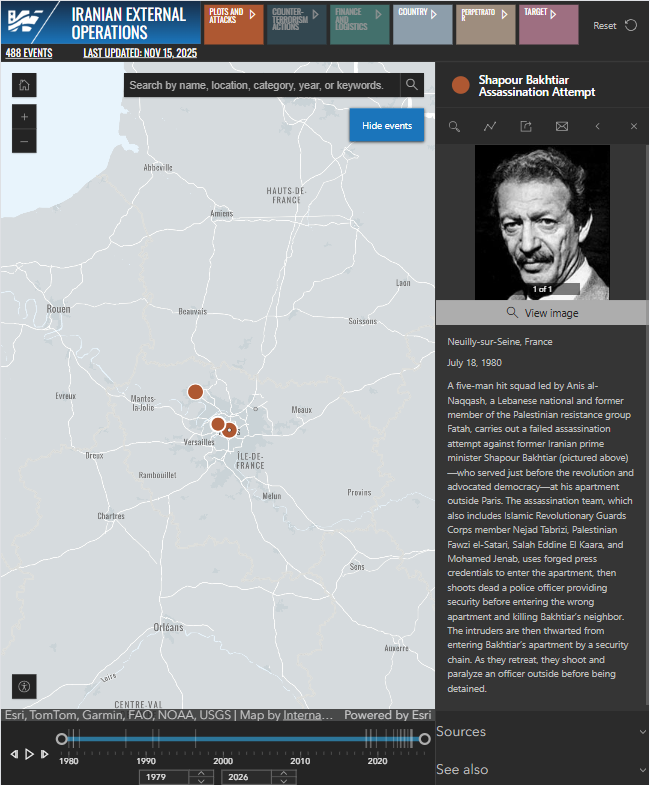
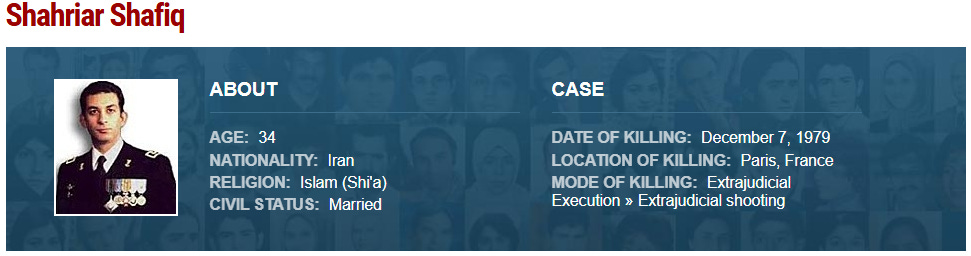
The report traces a decades-long pattern of Iranian state violence on French soil. Documented assassinations include Shahriar Shafiq, nephew of the last Shah, in 1979; Cyrus Elahi in 1990; and former Prime Minister Shapour Bakhtiar in 1991. These historical cases establish a pattern that continues into the present.
The 2018 Villepinte incident represents a watershed moment. Belgian authorities arrested Iranian diplomat Assadollah Assadi for orchestrating a thwarted terrorist attack against an Iranian opposition rally near Paris. Assadi’s conviction marked the first time a serving Iranian diplomat had been convicted of terrorism in Europe, providing concrete evidence of embassy involvement in violent operations.
Political Infiltration and the Palestinian Strategy
The investigation asserts that Iranian influence has been penetrating France’s political sphere, particularly the far-left movement La France Insoumise. The report alleges that certain deputies have become spokespeople for Tehran’s narratives, either unwittingly through propaganda or deliberately, citing public meetings organized with representatives of the Popular Front for Liberation of Palestine, designated a terrorist organization by the United States and European Union, and support for individuals with documented ties to Iranian proxy networks.
The investigation identifies what researchers call Iran’s “Trojan horse” strategy: leveraging the Palestinian cause to build alliances across France’s political spectrum and incite civil unrest. Since the October 7, 2023 Hamas attack, Iranian influence operations have intensified dramatically, exploiting the Gaza conflict to expand Tehran’s networks.
Ayatollah Ruhollah Khomeini himself designed this strategy. Having spent time in Palestinian guerrilla camps before 1979, Khomeini understood how framing Iran’s struggle in terms of Palestinian solidarity could garner sympathy beyond the country’s borders. The report notes that Tehran uses this cause “not out of love for Palestine, but to engage in the political battles of Western societies.”
Beyond physical operations, the investigation documents sophisticated influence campaigns on social media platforms. The report identifies networks of French-language influencers who receive direct or indirect support from Iranian intelligence services to spread pro-regime narratives, promote antisemitic conspiracy theories, and radicalize youth.
Not that France has made herself a hard target.
Upton Sinclair’s famous observation ““It is difficult to get a man to understand something when his salary depends on his not understanding it” needs but a modest tweak to explain Iran’s successful infiltration in France and elsewhere.
We start with the rather obvious, Qatar is Iran’s financial conduit to the West. And while Iran and Qatar may differ on certain religious matters (the former is Shi’a while the latter is Sunni), they are united in their theological goal of subduing the West … their ultimate religious reckoning will happen later.
So, here’s my stab at updating Sinclair: “It is difficult to get a politician to understand something when the lure of Qatari money depends on his not understanding it.”