


Jewish Onliner is an independent publication. If you find our work valuable, please consider becoming a paid subscriber. You can also subscribe to us on WhatsApp and Telegram. Follow us on YouTube, TikTok, Instagram, Discord, and X.
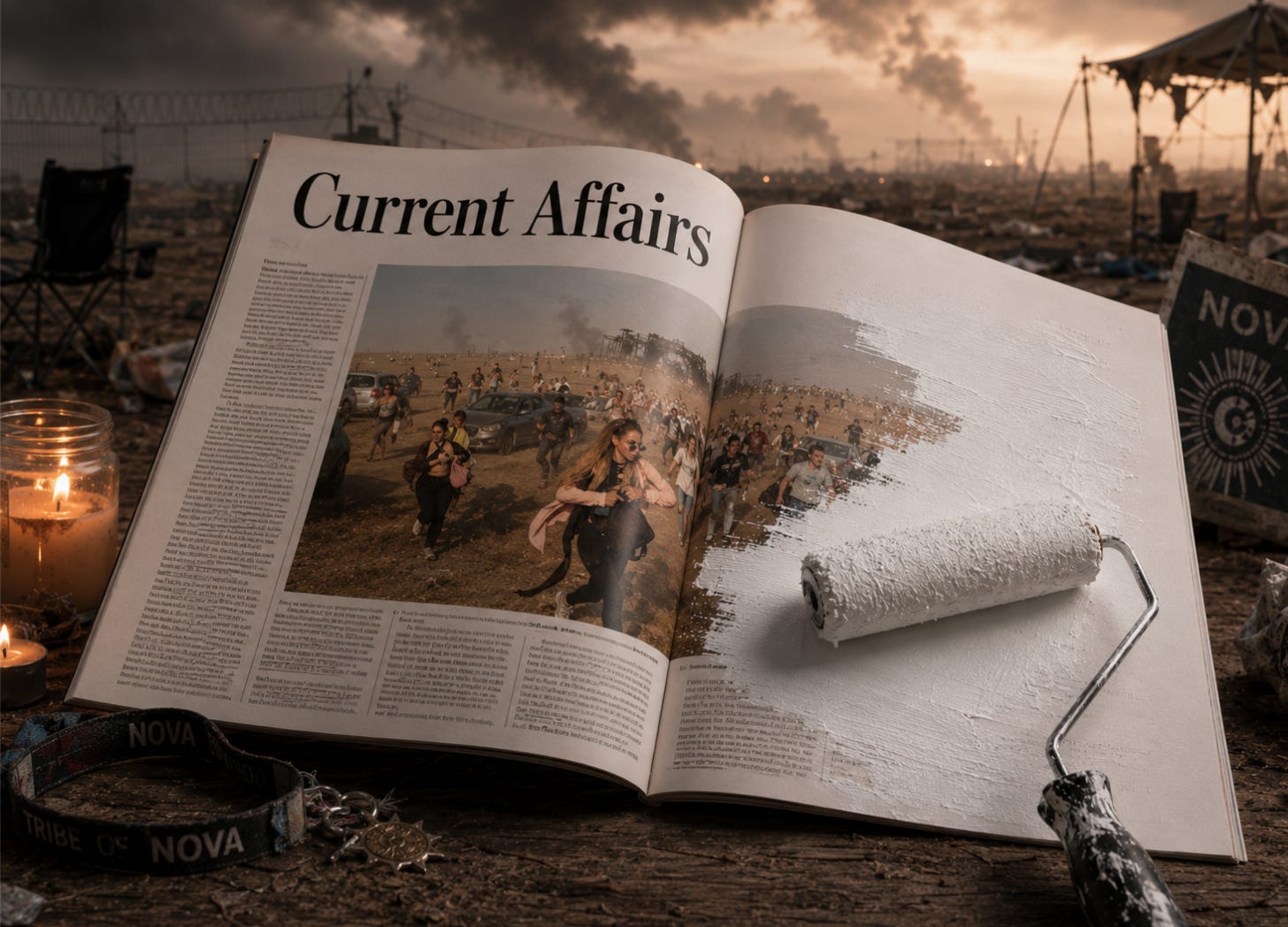
On August 3, 2026, the socialist American magazine Current Affairs published a roughly 6,000-word essay by SOAS doctoral student Zenab Huriyah Ahmed titled “Israel’s Rave Music Drowns Out the Sound of its Victims.”
The article recasts a music festival where hundreds of people were killed and dozens abducted as an expression of Israeli decadence, portrays Hamas terrorists as “fedayeen”, and ultimately places Israeli electronic music in the same moral category as music used by Nazi Germany.
Published nearly ten months after the October 10, 2025 ceasefire, the essay omits several central facts documented by the Israeli military’s inquiry into the Nova attack. It does not report that 378 people were killed in and around the festival or that 44 were abducted, and it does not identify any victim by name. Despite making broad claims about Israeli society and the Nova massacre, the essay contains no original interviews with Israeli musicians, festivalgoers, survivors or victims’ families.


Rewriting What Happened at Nova
Ahmed organizes several section headers around B7O and A7O, marking periods before and after October 7. The device makes the massacre the essay’s chronological reference point, even as the people killed and abducted that day remain largely absent from its account.
Ahmed describes the Nova festival site as “a well-funded dream of Hindu paganism.” Her brief account of the attack says most festivalgoers fled, others were caught in crossfire, and alleges that some were killed by Israeli police and security forces. The essay does not name an individual victim. Although it refers to hostages generally, it does not report that 44 people were abducted from Nova. Nor does it address evidence of sexual violence documented by UN investigations and Israel’s Civil Commission on October 7 Crimes.
The border kibbutzim attacked on October 7 are described as “military-agrarian complexes,” with their farmers characterized as “tools of social erasure.”
The essay’s clearest historical analogy predicts that Israeli electronic music will be remembered for its “fascistic utility” alongside Wagnerian opera and Beethoven symphonies in Nazi Germany. Ahmed also calls for new “Nuremberg Trials” for Israeli leaders.
Ahmed further argues that Zionism pressures Mizrahi Jews to suppress their Arab ancestry in favor of being “culturally Jewish,” and suggests that this heritage could be recovered if Zionism contracts. The essay concludes that Palestinians must “decisively get the upper hand” against Israel.


The Magazine Behind It
Current Affairs is run from New Orleans by editor-in-chief Nathan J. Robinson, a 36-year-old English-born Harvard PhD. Print circulation is 3,795. The magazine received 501(c)(3) charitable status in September 2023 — one month before October 7 — meaning American donors now receive a tax deduction for funding content comparing Israeli DJs to Nazi propagandists.
Its most recent Form 990 lists five employees, with Robinson drawing a $66,709 salary and his mother, Rosemary Robinson, serving as Secretary/Treasurer. Robinson himself was dismissed from The Guardian US in 2021 after tweeting that U.S. law required Congressional spending to buy Israeli weapons — a claim Guardian US editor John Mulholland responded to by citing “the prevalence of antisemitic tropes regarding Jewish control of American public life.” Robinson called Ahmed’s essay “remarkable.”


Part of an Editorial Pattern
The Ahmed piece is the culmination of a systematic editorial line. In April 2026, the magazine published “Israel’s New Lynching Law Is its Most Heinous Yet,” comparing Israeli law to Jim Crow. In March 2026, “First the Cherokee, Now the Palestinians”.
The significance of the essay lies less in any single phrase than in the editorial framework Current Affairs accepted. Ahmed assigns political responsibility to Israeli cultural life while presenting Palestinian terrorism through the vocabulary of “resistance.” Robinson’s public praise, combined with the magazine’s uniformly critical 2026 Israel/Palestine coverage, places the piece within a broader editorial line rather than as an isolated contribution.