


Jewish Onliner is an independent publication. If you find our work valuable, please consider becoming a paid subscriber. You can also subscribe to us on WhatsApp and Telegram. Follow us on Instagram, Discord, and X.
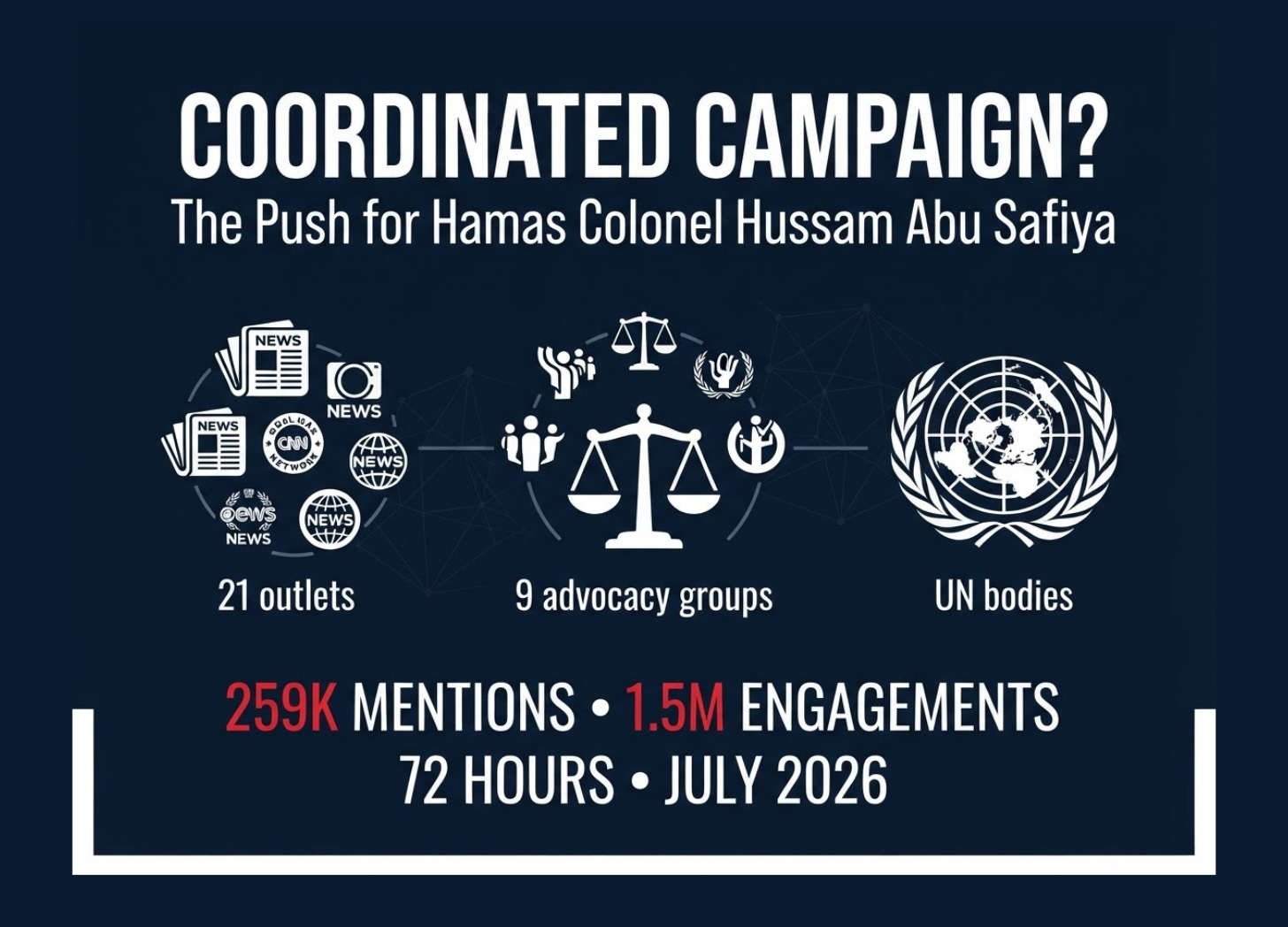
In the first week of July 2026, a wave of articles, advocacy statements, and social media posts flooded digital platforms with a unified demand: Israel must release Dr. Hussam Abu Safiya, the detained director of Gaza’s Kamal Adwan Military Hospital who holds the rank of colonel in Hamas.
Within roughly 36 hours, major news outlets and advocacy organizations issued analogous statements and petitions with matching talking points.
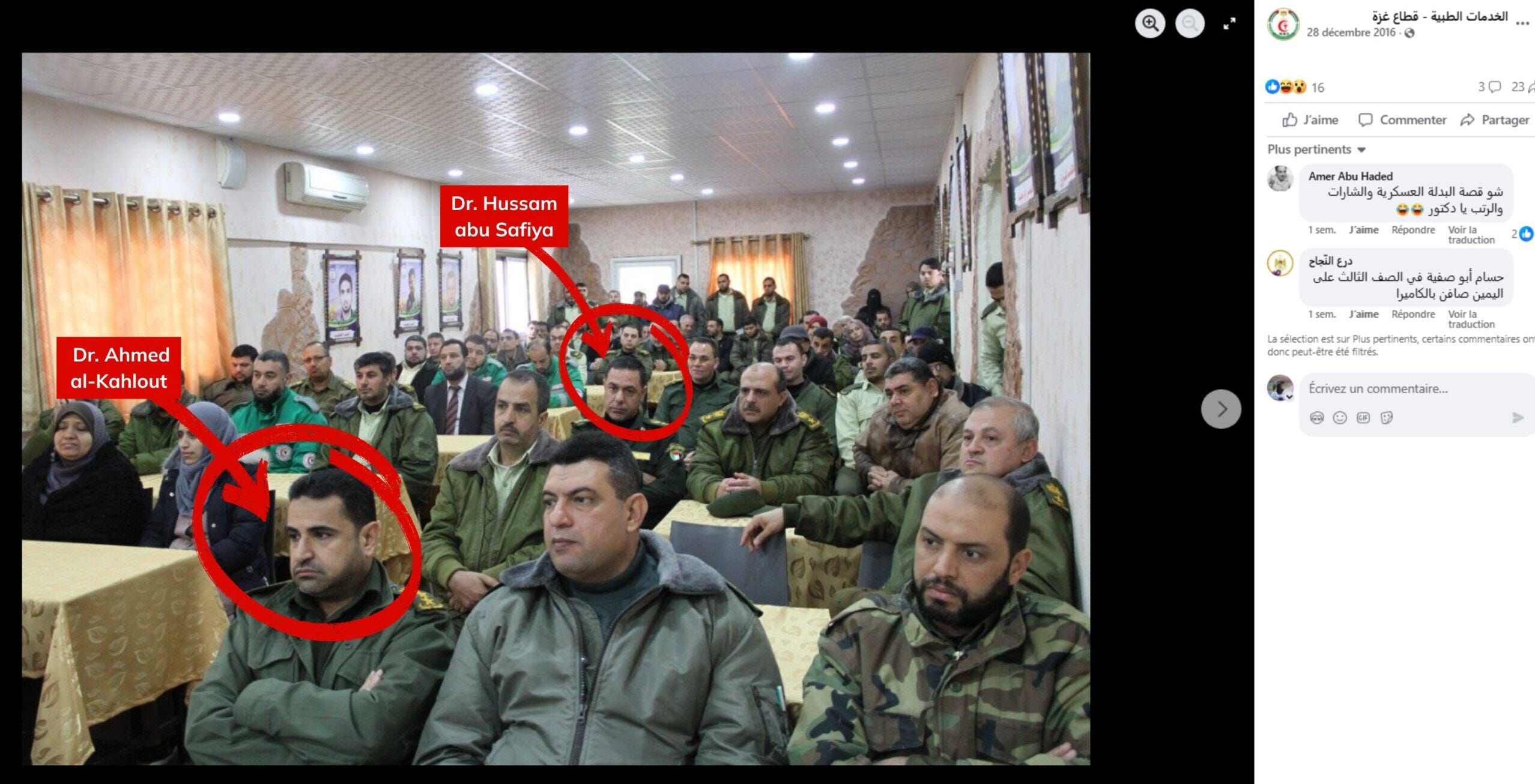
What distinguishes this from typical news coverage is the timing, uniformity of messaging, and potentially coordinated rollout across advocacy and media ecosystems — all centered on a figure whose Hamas affiliation has been documented by Israeli intelligence, independent researchers, and even Hamas-controlled sources.
Narratives Promoted in Tandem
The campaign’s trigger was a July 2 prison visit by attorney Nasser Odeh, arranged by Physicians for Human Rights Israel. By July 5, the narrative had propagated across continents with remarkable uniformity. Qatar’s state-run Al Jazeera published a story, as did the Washington Post and Associated Press, and The Guardian.
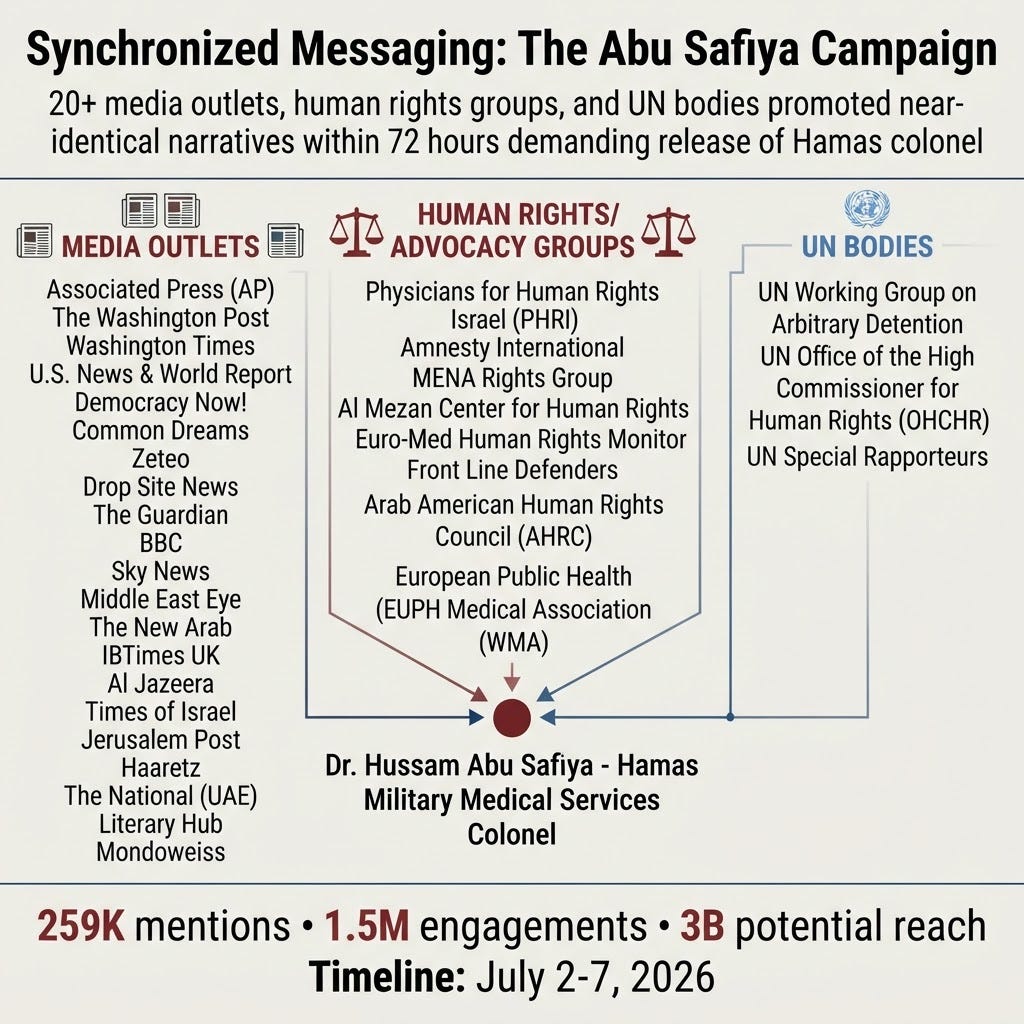
Drop Site News, Qatar-linked Middle East Eye, Sky News, BBC, and CNN all covered the story using near-identical framing — with minimal or no mention of Israeli allegations that he held the rank of colonel in Hamas’s “Military Medical Services.”
The highly similar messaging extended beyond news coverage. MENA Rights Group filed the complaint to the UN Working Group on Arbitrary Detention, while Amnesty International launched a petition calling Abu Safiya “a prominent voice of Gaza’s decimated healthcare sector.”
On July 7, UN Special Rapporteurs urged Israel to immediately release Abu Safiya. The UN statement was immediately amplified by media outlets and advocacy groups as independent validation.
The Social Media Surge
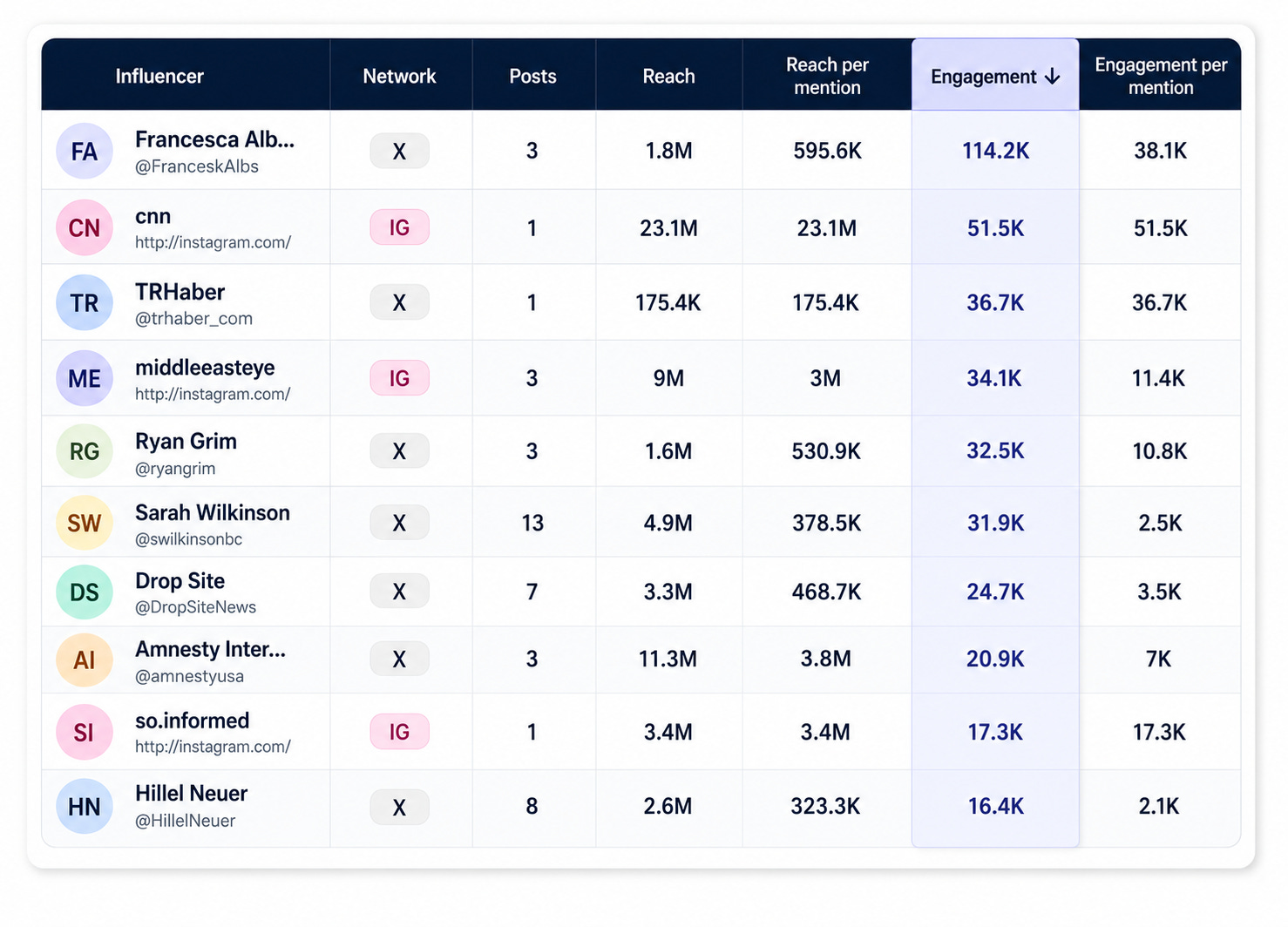
Social media tracking data reveals the campaign’s extraordinary reach and its most effective amplifiers. The mobilization generated 259,000 mentions, produced 1.5 million engagements, and reached a potential audience of 3 billion people. The close proximity of the articles produced a dramatic spike in mentions during the first week of July, far exceeding baseline discussion of Abu Safiya’s detention.
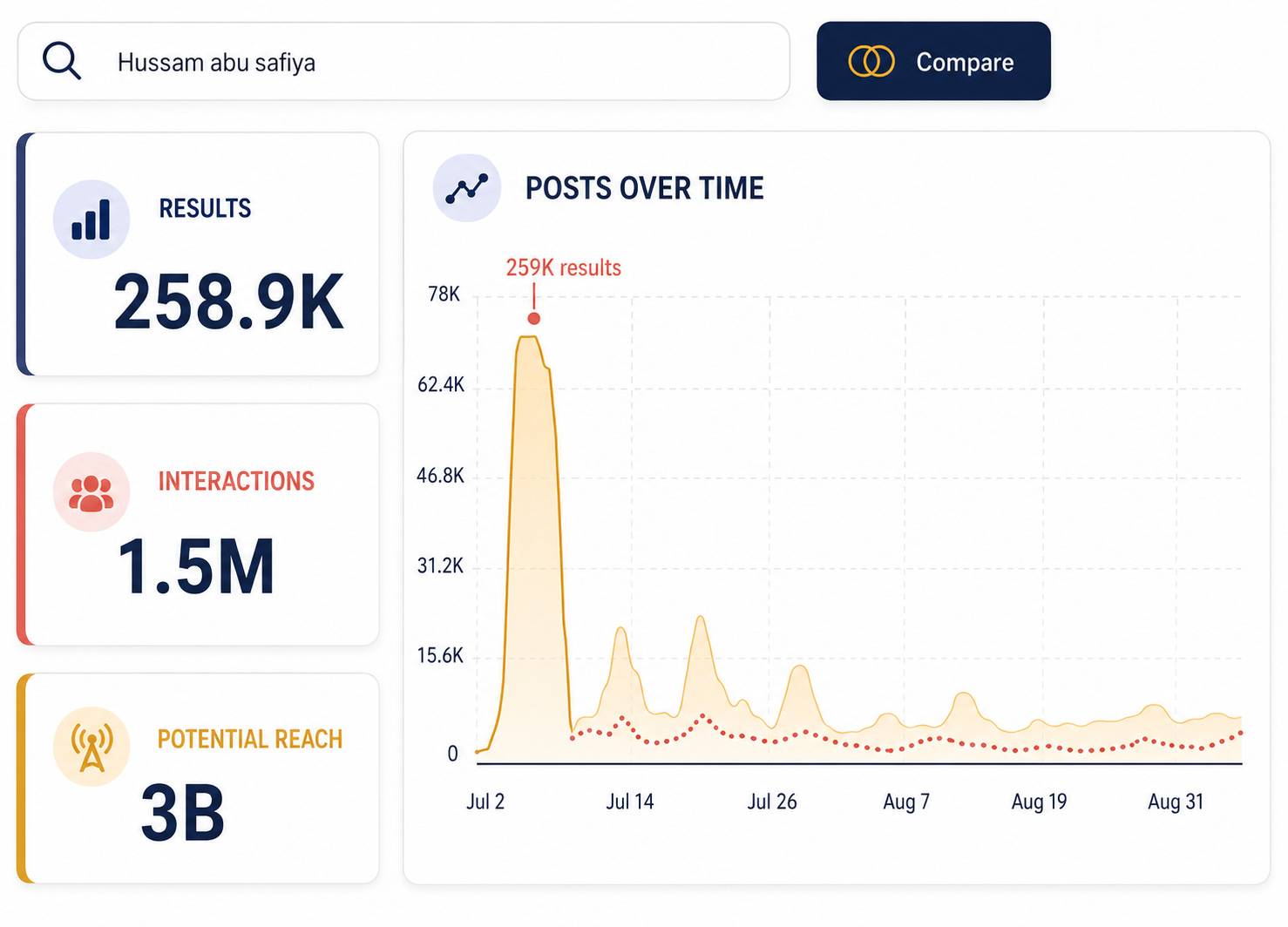
UN Special Rapporteur Francesca Albanese generated 114,200 engagements across three posts on X, reaching 1.8 million people. CNN’s Instagram account drove 51,500 engagements with a single post. Ryan Grim, whose Drop Site News outlet defended Abu Safiya against “propaganda” after his Hamas uniform photo surfaced, generated 32,500 engagements. Qatar-linked Middle East Eye (34,100 engagements), and Turkey state-run TRHaber (36,700 engagements) rounded out the top influencers, collectively amplifying the campaign to tens of millions.
Highly Organized Advocacy-Media Ecosystem
Taken together, the timing, repetition, and amplification patterns suggest a highly organized advocacy-media ecosystem rather than a purely organic news cycle.
The Abu Safiya campaign generated more than a quarter-million mentions and 1.5 million engagements in a matter of days, amplified by UN officials, advocacy organizations, and major news outlets that advanced broadly similar narratives on closely aligned timelines.
The effect was to push Abu Safiya’s detention to the center of global attention while giving far less prominence to his documented Hamas rank and Israel’s allegations regarding Kamal Adwan Hospital. The episode shows how fast, disciplined messaging can shape international perception and make the line between independent journalism and advocacy harder to distinguish.