


Jewish Onliner is an independent publication. If you find our work valuable, please consider becoming a paid subscriber.
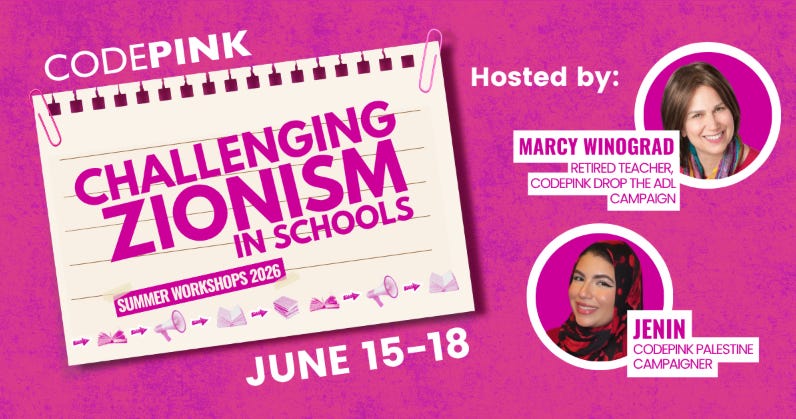
A June 17 CODEPINK webinar on “Challenging Zionism in Schools” showed how anti-Israel classroom materials promoted by CODEPINK-linked educators are being distributed through Share My Lesson, the American Federation of Teachers’ online resource platform for educators.
A review by NAVI K-12 Extremism Tracker found that Share My Lesson has hosted materials that frame Palestinian protest art as “resistance,” present anti-Zionist definitions of Zionism alongside neutral reference definitions, and, according to NAVI, include a separate lesson built around Osama bin Laden’s “Letter to America.”
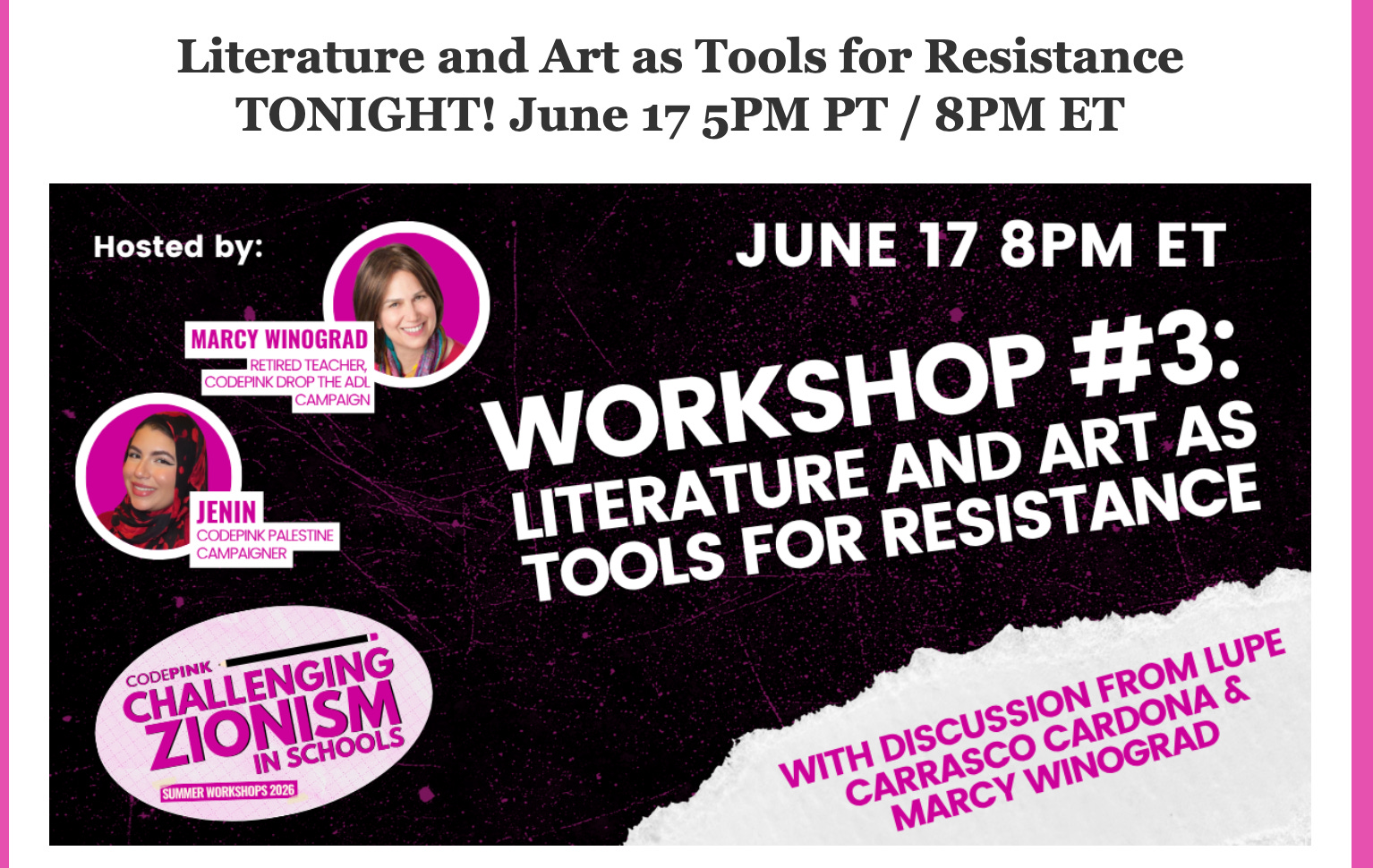
The June 17 session listed Marcy Winograd, coordinator of CODEPINK’s Drop the ADL campaign and chair of CTA Jewish & Allied Educators 4 Palestine, alongside Lupe Carrasco Cardona, chair of the Association of Raza Educators and a founding member of the Liberated Ethnic Studies Model Curriculum Coalition. The key finding is that some of these materials are hosted on AFT’s Share My Lesson platform, giving activist-created curriculum a union-branded distribution channel to a site that describes itself as serving nearly 2.3 million educators.
AFT Platform Hosts User-Uploaded Anti-Israel Lessons
Winograd has uploaded lessons to Share My Lesson, AFT’s free educator-resource site. One lesson, “Palestine Art as Resistance: Graffiti on the Apartheid Wall or Separation Barrier,” asks students to analyze murals on what the lesson calls “Israel’s ‘apartheid wall’” and what Israel describes as the “separation barrier,” then write an essay on whether the protest art is justified.
According to NAVI’s review of the webinar, Winograd addressed the argument that Israel built the barrier in response to Palestinian terror attacks by saying, “there would not be problems if it were not for Israel’s colonization and ethnic cleansing.”
Another Winograd lesson on Share My Lesson presents students with two definitions of Zionism side-by-side. The Encyclopedia Britannica’s factual definition as “political support for the creation and development of a Jewish homeland in Israel,” and the Palestine Policy Network’s characterization as “a settler-colonial ideology aimed at establishing a Jewish state in historic Palestine by eliminating the indigenous Palestinian people.”
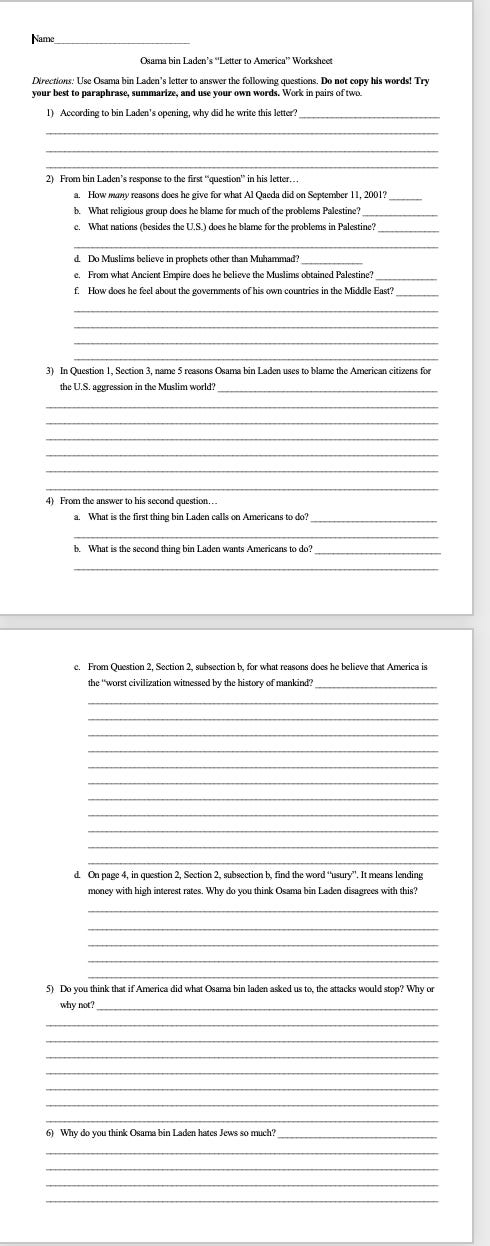
NAVI also identified a separate Share My Lesson resource on Osama bin Laden’s “Letter to America,” which NAVI said was authored by a New York public school teacher and had been downloaded more than 200 times. NAVI reported that the lesson has students read bin Laden’s justification for 9/11 and answer questions including “What religious group does he blame for much of the problems [in] Palestine?” and “Why do you think Osama bin Laden hates Jews so much?” NAVI also said the lesson’s author is followed on the platform by Kelly Booz, Director of Share My Lesson.
The AFT claims it cannot screen all content uploaded to the site but can remove lessons that violate AFT policy or are “harmful or objectionable.” Yet these materials remain accessible.
Teaching Students to Produce Anti-Israel Content
The webinar’s theme was “Literature and Art as Tools for Resistance,” and according to NAVI’s review, both presenters framed their goal as extending beyond education to activism. Carrasco Cardona, who trains teachers through the California Teachers Association’s Human Rights Department, explained that ethnic studies lessons must “critique empire” and “challenge imperialist colonial hegemonic beliefs,” or they’re merely “diversity lessons,” not true ethnic studies.
Her lesson plan on Edward Said’s “Orientalism” for grades 7-12 shows students a short film about a Palestinian girl who learns from her grandfather that her family is from Jaffa (a city in Israel, which he calls Palestine) and that they will “return” one day. The girl returns to school wearing a keffiyeh and a necklace depicting “Palestine,” with Israel erased. Students are not asked to critically examine Said’s theories but to adopt them, then create “social media memes” based on Said’s quotes about Orientalism.
“These lessons are supposed to really be about helping students to name these things and then helping them to find whatever it is that is what they were meant to do, what they feel like is their place in the world to take action,” Carrasco Cardona said. The point is explicit, transform students from passive learners into activist content producers.
How Jewish Identity Gets Reframed
Throughout the webinar, according to NAVI’s review, presenters and participants characterized Jewish claims to Israel as religious supremacism. When asked how to counter the argument that “this is Jewish land” that “has been Jewish land for thousands of years,” Winograd dismissed it as “an excuse for privilege, for the privilege to ethnically cleanse.” CODEPINK’s Palestine campaigner Jenin Mahdi added that the conflict is “an issue rooted in just supremacist ideology,” not a religious issue, but one of “settler colonialism and really dangerous nationalism.”
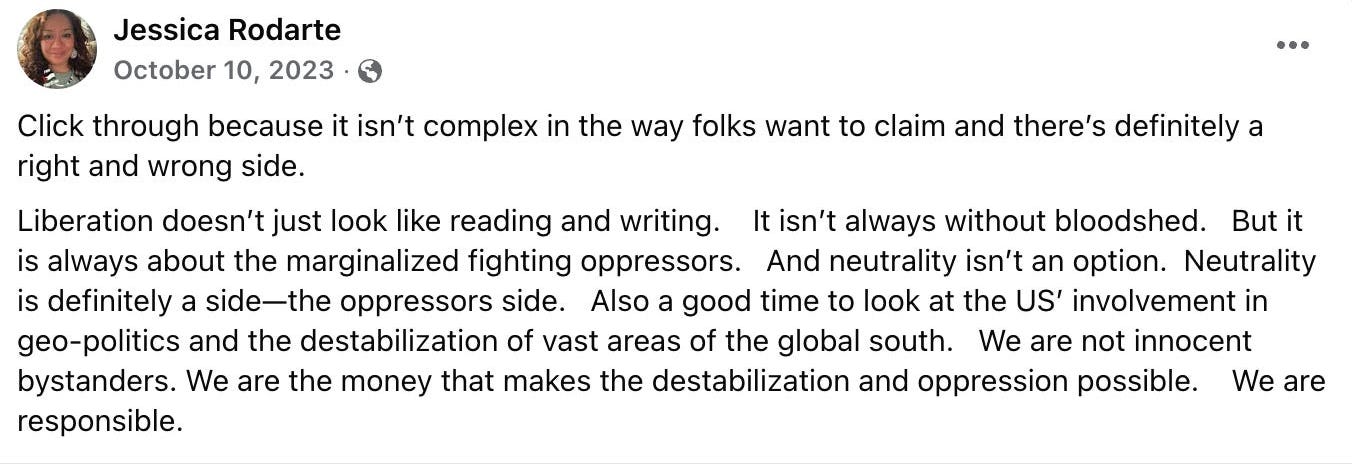
Carrasco Cardona, who was filmed at a 2024 UTLA leadership conference suggesting Israel placed the Star of David on its flag to deflect criticism as antisemitism, claimed she would defend any group facing dehumanization “but right now, that’s not the case.” After October 7, 2023, the largest single-day massacre of Jews since the Holocaust, NAVI’s review found that Carrasco Cardona’s public social media remained silent about the attack, and that two weeks later she began posting about genocide. Her UTLA colleague Jessica Rodarte was more direct, posting on October 10, 2023 “Liberation doesn’t just look like reading and writing. It isn’t always without bloodshed.”
Winograd also criticized California’s AB715, a law signed by Gov. Gavin Newsom to strengthen K–12 enforcement against antisemitism and discrimination, arguing that it “conflates criticism of Israel as a Jewish state, a supremacist state, with antisemitism.” That claim sits uneasily with the IHRA definition’s own caveat that criticism of Israel comparable to criticism of any other country is not antisemitic.
Deep Ties to Teacher Union Infrastructure
The influence these activists wield extends far beyond a single webinar. Winograd leads a pro-Palestine caucus within the California Teachers Association. Carrasco Cardona ran for UTLA AFT vice president in the 2025–2026 election, losing narrowly with 49.24% of the vote, 118 votes behind the winner. She works in the CTA’s Human Rights Department training educators on “social justice” and received the CTA’s Human Rights Award in 2022 for developing the Liberated Ethnic Studies Model Curriculum.
Her colleague Ron Gochez, a founding member of Union del Barrio and recipient of the CTA’s Cesar Chavez Human Rights Award, was cited by the Department of Homeland Security for remarks at an anti-ICE protest, “They [ICE] are not the only ones with guns in this city. Don’t forget that.” In a 2002 letter to a student newspaper, Gochez wrote about the “Jewish-owned media” that “continue[s] to blind the masses with propaganda.”
CODEPINK has separately faced Republican congressional scrutiny over alleged foreign-influence ties, including questions about Neville Roy Singham-linked funding networks, and Medea Benjamin has denied wrongdoing while acknowledging scrutiny over a March 2026 Cuba trip.
The Pathway Into Classrooms
Share My Lesson provides a national, AFT-branded distribution channel for user-uploaded classroom materials, including activist-created lessons promoted through the CODEPINK webinar. By allowing unvetted uploads from activists like Winograd, the platform gives radical materials the imprimatur of a national teachers union representing 1.8 million members. The materials go beyond neutral background instruction, presenting anti-Zionist advocacy in classroom-ready form and, in at least one lesson discussed during the webinar, asking students to create social media-style content around the assigned political framework. And they do it under the banner of America’s second-largest teachers union.