


Jewish Onliner is an independent publication. If you find our work valuable, please consider becoming a paid subscriber.
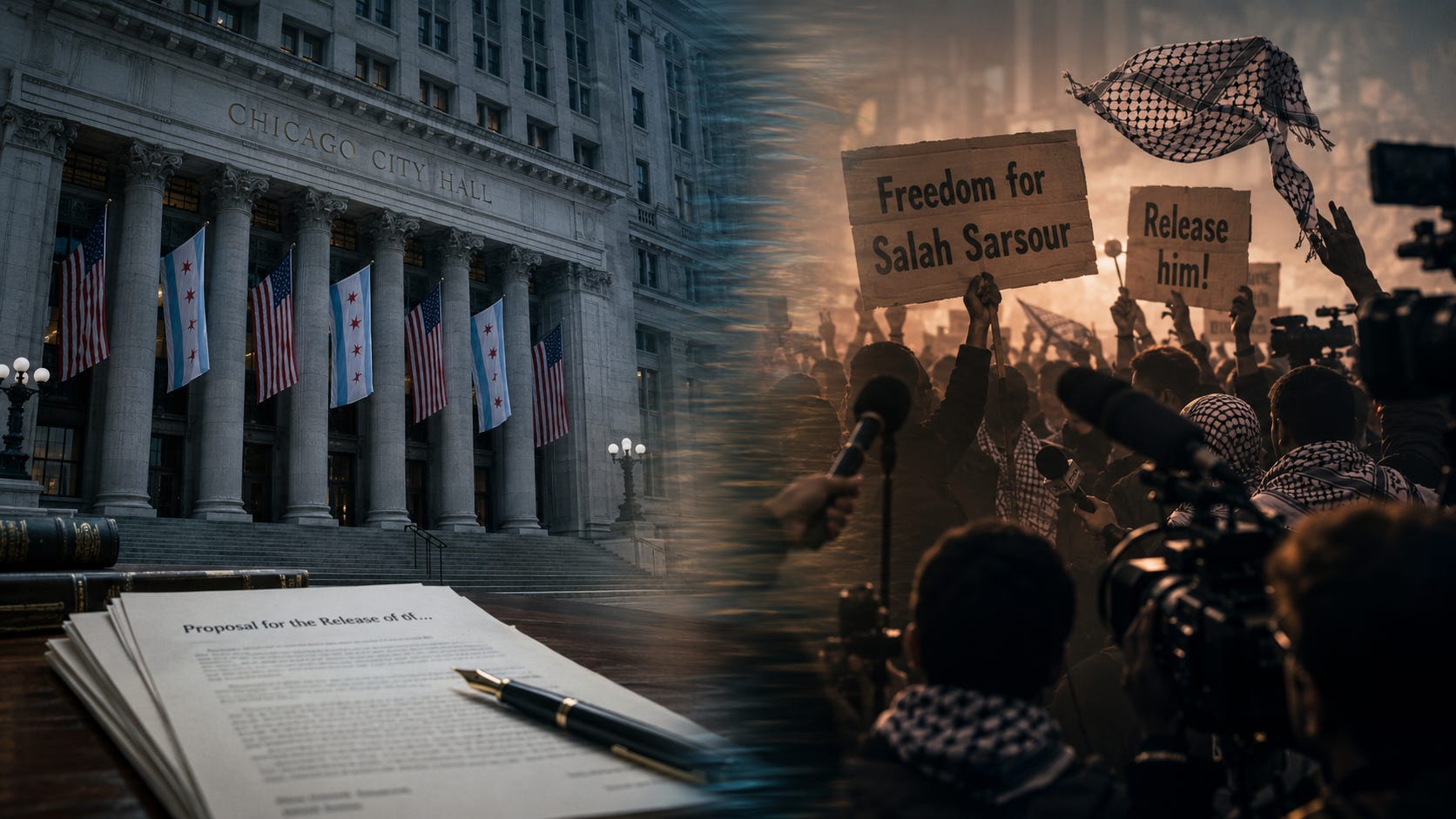
Three Chicago aldermen aligned with Chicago’s democratic socialist politics are backing a resolution calling on DHS and ICE to release Salah Sarsour, a Milwaukee mosque president and whom DHS describes as suspected of funding terror organizations, accused of lying on immigration forms, and previously convicted in Israel for throwing Molotov cocktails at homes of Israeli armed forces.
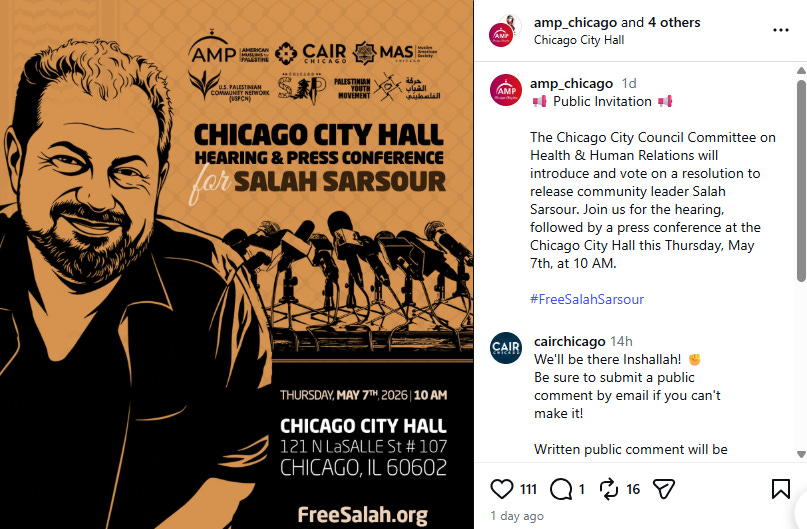
The May 7 hearing on Resolution R2026-0024891 is being promoted by AMP-Chicago, CAIR-Chicago, and allied groups. The campaign places Chicago aldermen alongside organizations facing separate scrutiny: AMP is under a Virginia Attorney General investigation involving terror-financing allegations, CAIR has been targeted by state-level terrorist-designation actions in Texas and Florida, and a March 2026 House committee report described groups such as Students for Justice in Palestine as “ringleaders” of campus antisemitism.
The Resolution and Its Sponsors
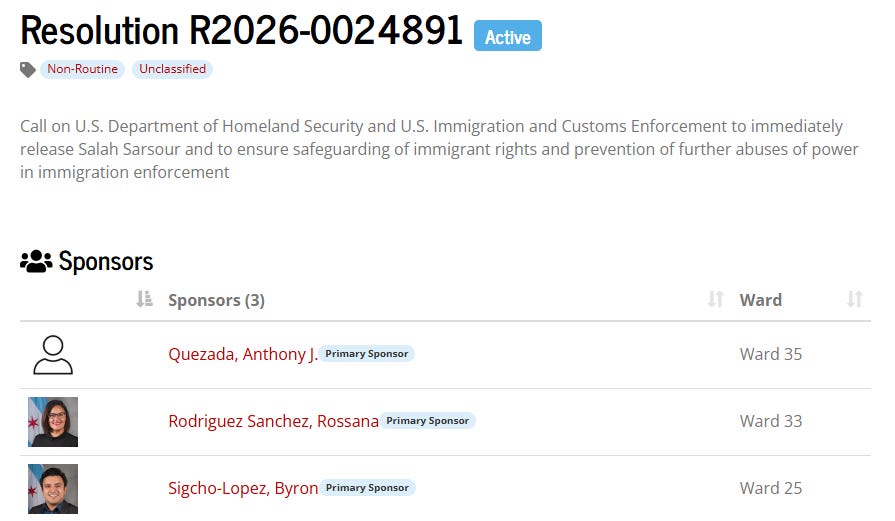
The sponsors include Rossana Rodriguez-Sanchez and Byron Sigcho-Lopez, members of the City Council’s Democratic Socialist Caucus, and Anthony Quezada, who describes himself as a democratic socialist.
Resolution R2026-0024891, introduced on April 15, calls on DHS and ICE to “immediately release Salah Sarsour” and frames his detention as an abuse of federal immigration enforcement. Rodriguez-Sanchez, who chairs the Health and Human Relations Committee, signed the agenda placing it for a vote. Sigcho-Lopez, who is currently running for U.S. Congress, and Quezada, who represents the 35th Ward, joined as primary sponsors.
The Federal Allegations
DHS says Sarsour’s initial U.S. visa application was denied due to Israeli convictions for throwing Molotov cocktails and attempting to possess weapons and ammunition. The agency says he obtained his green card in 1998 by lying about his criminal history and is “suspected of funding terror organizations.”


Acting Assistant Secretary Lauren Bis described Sarsour as “a terrorist convicted of throwing Molotov cocktails at the homes of Israeli armed forces.” DHS and Sarsour’s attorney have said the government is relying in part on a determination by Secretary of State Marco Rubio that Sarsour’s presence could pose a “serious adverse foreign policy” concern.
Sarsour was profiled on Canary Mission as a “Hamas activist and financier” in posts dating back to 2019. The site cites a 1999 Israeli police report containing a transcript in which Sarsour’s brother Jamil reportedly told investigators that the two had sent money from their Milwaukee business to a Hamas leader. A separate 2001 FBI memo on the profile claims Sarsour raised money for the Holy Land Foundation — the Muslim charity whose leaders were later convicted of funneling money to Hamas in what federal prosecutors called the largest terror financing case in U.S. history.
The Coalition’s Legal Issues
The aldermen’s resolution is being publicly promoted by the broader coalition that organized an April 20 Capitol Hill press conference for Sarsour: American Muslims for Palestine (AMP), CAIR, the Muslim American Society, the U.S. Council of Muslim Organizations, and the Muslim Legal Fund of America.
AMP, where Sarsour serves as a board member, is the subject of a Virginia Attorney General investigation over alleged terror financing and is the defendant in Boim v. American Muslims for Palestine, a federal civil case in which plaintiffs argue the group functions as the “alter ego” of a defunct nonprofit found liable for a Hamas terror killing.
Florida Gov. Ron DeSantis and Texas Gov. Greg Abbott have issued state-level actions seeking to treat CAIR as a terrorist-linked organization.
A Municipal Body, A Federal Case
Chicago has no authority to order DHS or ICE to release Sarsour, and no power to decide his federal immigration case. The resolution is therefore symbolic, but not insignificant. By lending the city’s institutional voice to Sarsour’s release campaign, despite DHS’s allegations and the legal controversies surrounding several advocacy groups backing him, the three aldermen are making a clear political choice. The May 7 hearing will show whether the broader Chicago City Council is willing to join them.