


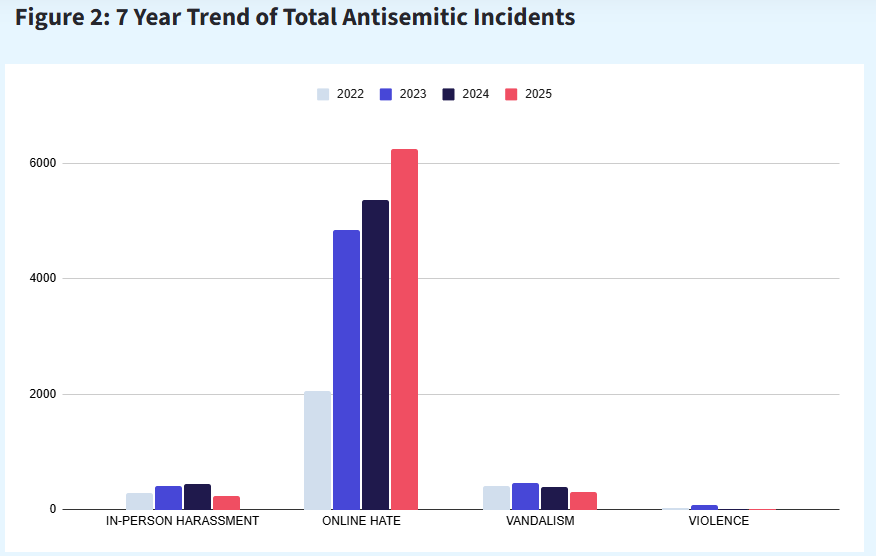
Antisemitic incidents in Canada reached an unprecedented 6,800 cases in 2025, marking a 9.3% increase from the previous year’s record of 6,219, according to the Annual Audit of Antisemitic Incidents released by B’nai Brith Canada’s League for Human Rights. The figures represent an average of 18.6 antisemitic incidents per day targeting Jewish Canadians—a staggering escalation from 8 daily incidents recorded in 2022, and a 145.6% increase across the three-year period.
The 2025 audit documents a dramatic transformation in how antisemitism manifests. Online harassment now accounts for 92% of all reported incidents, up from 84% in 2023 and 86% in 2024, signaling a sustained shift toward digital platforms as the primary arena for antisemitic hostility.
Of the 6,800 total incidents, 6,491 were classified as harassment, 299 as vandalism, and 10 as violence. November and December 2025 recorded unprecedented monthly totals of 982 and 1,404 incidents respectively, with the consistency of month-to-month increases suggesting this is not a temporary surge tied to single events but an entrenched post-October 7 reality.
Geographic Surge and Anti-Zionism’s Role
Ontario accounted for the highest concentration of incidents with 3,194 cases in 2025—a 79.2% surge compared to 2024. The Atlantic region experienced a 114.5% increase, British Columbia reported a 26.2% rise, and the Prairies documented an 88.1% jump, underscoring what B’nai Brith characterizes as a national crisis affecting diverse geographic areas simultaneously.
The audit identifies the demonization of Zionism as a significant driver of 2025’s spike. B’nai Brith documents coordinated efforts by student unions, militant left-wing groups, and political actors to stigmatize Zionism—often conflating it with settler colonialism and framing support for Jewish self-determination as moral justification for harassment.


McGill University implemented a “Policy Against Genocide in Gaza” in April 2025 that frames Israeli governance as “settler-colonial apartheid,” employing language that implicitly rejects Jewish indigeneity to the region. Jewish members of 2SLGBTQIA+ communities identifying as Zionists faced specific exclusion from Pride events across Canada.
During the 2025 federal election, Jewish candidates had campaign posters defaced with Nazi imagery and antisemitic iconography, with perpetrators citing anti-Zionist motivations. Stickers and graffiti in multiple cities explicitly urged residents not to date Zionists, while ride-share drivers refused service to Jewish and Israeli passengers citing Zionist beliefs.
The Association for Canadian Jewish Studies published research in 2025 showing that most Canadian Jews—who support Jewish self-determination—increasingly refrain from using the label “Zionist” due to external pressure and social stigma.


Institutional Antisemitism on Campuses
The 2025 audit catalogs systematic antisemitism across Canadian post-secondary institutions, with faculty involvement documented in several cases. The Canadian Association of University Teachers released a report in March 2025 characterizing antisemitism-combat efforts as threats to academic freedom.
The University of Toronto hosted an event in January featuring a convicted member of the Popular Front for the Liberation of Palestine (PFLP)—a Canadian-designated terror organization—only cancelled after B’nai Brith Canada intervened.
University of Toronto Event With PFLP Terrorist Canceled After Mounting Pressure

Three University of Toronto student groups and the Watermelon Coalition have canceled a planned event featuring Shadi Shurafa, a convicted member of the Popular Front for the Liberation of Palestine terrorist organization, following mounting pressure and media coverage,
Normalization of Antisemitism
The Annual Audit, first published in 1982, has been cited by the U.S. Department of State, Statistics Canada, and the Kantor Centre for the Study of Contemporary European Jewry. B’nai Brith notes that while the October 7, 2023 Hamas attack initially drove surges in antisemitism, the sustained 145.6% increase over three years indicates normalization rather than reactive spikes.