


Jewish Onliner is an independent publication. If you find our work valuable, please consider becoming a paid subscriber.
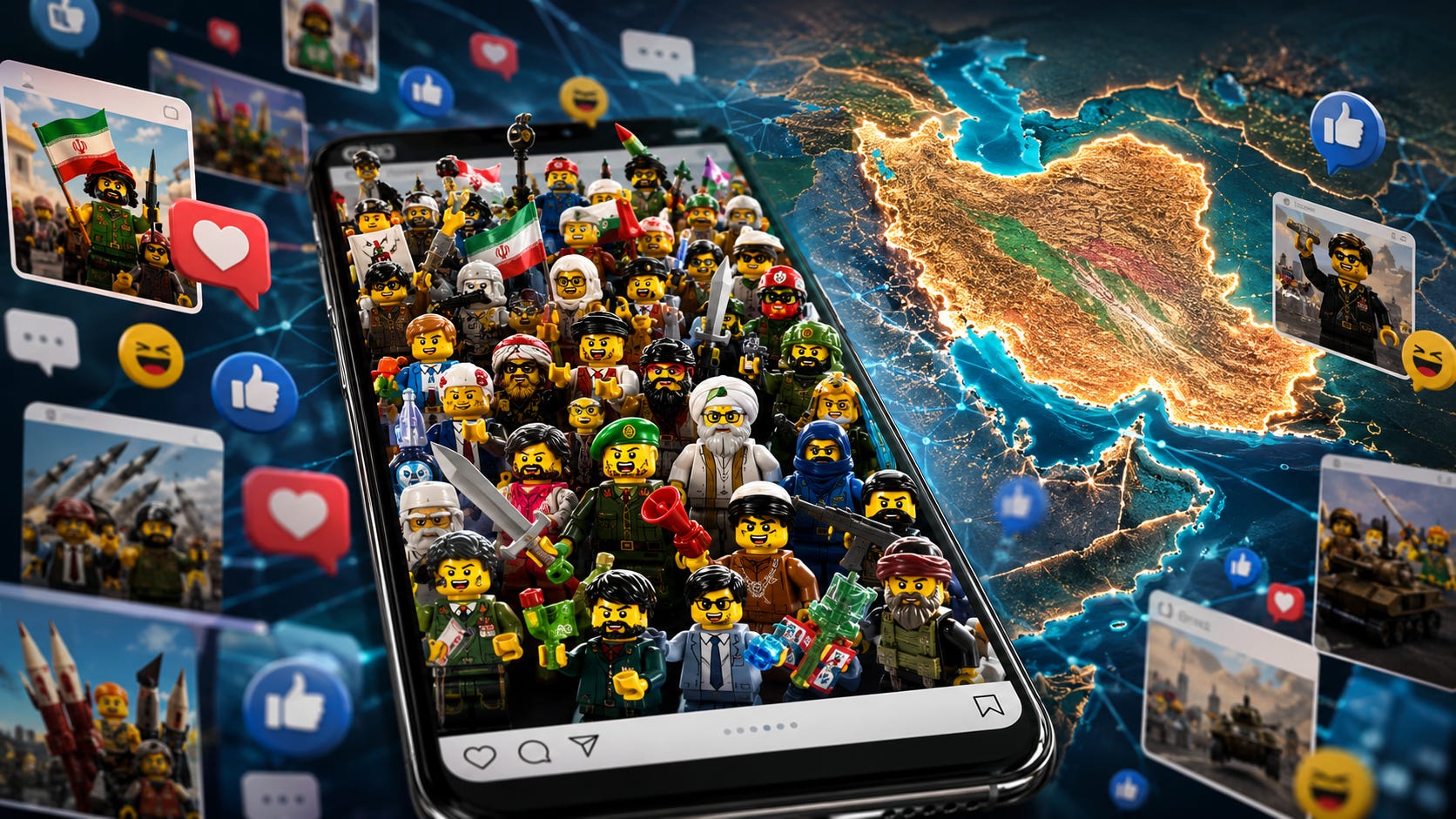
Rapid Response Mechanism Canada has directly linked a viral social media influence operation using AI-generated Lego-style characters to the Iranian state, concluding that the campaign promoted Tehran’s messaging during the March 2026 U.S.-Iran conflict while targeting Western audiences in English.
In its report, “Explosive Media: Iranian state-linked AI Lego-style videos claiming that Tehran has ‘won the propaganda war’”, released on July 10, RRM Canada said the operation criticized U.S. President Donald Trump’s handling of the hostilities and at times expanded its focus to include Israel and Gulf Arab states.
The report identifies the campaign’s central vehicle as Explosive Media, a Tehran-based outlet that published short-form AI videos designed for mass sharing across mainstream platforms. Based on open-source analysis, RRM Canada assessed that Explosive Media was likely linked to Saeed Jalili, the supreme leader’s representative on Iran’s Supreme National Security Council
Explosive Media denies being state-run and describes itself as an independent outlet supported by cryptocurrency donations. However, a representative separately told the BBC that the Iranian government was a customer of the group, while denying that its members were government employees.

A Rapid Pivot from Farsi to English
According to RRM Canada’s findings, Explosive Media first established a presence on Telegram and Instagram on June 25, 2025, publishing Farsi-language vertical videos about the so-called “12 Day War.” Those early videos used human hosts, drew limited engagement, and were aimed primarily at domestic or Farsi-speaking audiences.
That changed on March 7, 2026, when the outlet shifted from Farsi commentary to English-language generative AI videos built around Lego-style figures. The change sharply increased engagement, especially among Western users. RRM Canada said the content was soon distributed not only on Telegram and Instagram but also on TikTok, Rumble, Threads, BlueSky, UpScrolled, Spotify, and SoundCloud. Of those platforms, TikTok generated the highest number of views.
The operation’s core message was consistent: Iran had outperformed its adversaries in the information space and had, in the report’s phrasing, “won the propaganda war” in the Persian Gulf.


How Ottawa Traced the network
The most consequential part of the Canadian assessment is its attribution chain. RRM Canada reviewed Explosive Media’s Telegram output and identified a recurring male host, described in the report as “Individual 1,” who appeared in more than 20 Farsi-language videos from the outlet’s early phase. Investigators then found a March 17, 2026, AI Lego-style video on Explosive Media’s Instagram account listing “M. Taha Ansari Mohseri” as a collaborator. Under Meta’s system, RRM Canada noted, that the collaborator tag would have required approval.
Canadian analysts said Mohseri strongly resembles the recurring host featured in Explosive Media’s earlier Farsi videos. The report then links Mohseri to Jalili’s political apparatus, stating that he was part of Saeed Jalili’s social media team during Jalili’s unsuccessful 2024 presidential campaign and continued to appear in Jalili’s official Telegram and Instagram presence.
The report also cites posts from Jalili’s “aqaye.president” Instagram account and “aqaye_president” Telegram channel, dated December 2024 and January 2025, which it says directed followers toward Mohseri and Explosive Media.
Scale, Virality, and Platform Spread
RRM Canada estimates that at least 83 million users globally viewed the videos in the first month of the U.S.-Iran conflict in March 2026. Because many videos were later removed for violating platform rules, the report says the true number is likely higher. Its broader estimate is that roughly 200 million users viewed at least one AI Lego-style video in March alone.
The report says Russian and Iranian state-controlled media helped boost the first video on X in the first 12 hours, citing accounts including RT and Iran Radio PS. But it also concludes that those state amplifiers played only a limited role in sustaining the campaign’s reach. Just 4 million views, 4.38 percent of the 83 million total views measured in the report’s first-month window, came from accounts with IP locations in Russia or Iran, suggesting the operation achieved mainstream traction far beyond its initial state-aligned push.
RRM Canada goes further, assessing that the Explosive Media campaign was likely the most widely viewed foreign information operation since the start of 2026, surpassing comparable malign activity linked to Russia or other state actors.
The report also cites estimates from the Institute for Strategic Dialogue that Iran’s wider AI-driven media ecosystem that includes Minecraft-style and Pixar-like content may have amassed more than 1 billion views in the conflict’s opening month.
Why the Format Mattered
The Canadian report attributes much of the campaign’s success to format as much as message. It cites analysis from the Atlantic Council’s Digital Forensic Research Lab, which said the videos used humor and stylistic familiarity to reach “politically uninvested” users who might otherwise ignore war content.


RRM Canada assessed that many Canadian users under 16 were likely among those who encountered the content between March and June, given its use of youth-oriented intellectual property. The growing number of copycat accounts could make it more difficult to distinguish state-linked content from independent imitation in future campaigns.
RRM Canada’s findings suggest that the campaign was significant not simply because Iranian propaganda adopted generative AI, but because a state-linked network used familiar entertainment aesthetics to place wartime narratives before vast global audiences far beyond its original political base.