


Jewish Onliner is an independent publication. If you find our work valuable, please consider becoming a paid subscriber.

A new report from the Combat Antisemitism Movement’s Antisemitism Research Center says its researchers observed Instagram recommendations moving two fresh test accounts from mainstream self-improvement content into conspiratorial and antisemitic material within days.
The study, conducted between May 8 and May 14, 2026, used two new Instagram personas built around wellness and biohacking, and fitness and discipline. CAM said both accounts followed only mainstream creators before the platform served them content that escalated from clean eating and fitness motivation to conspiracy theories, coded antisemitic narratives, and explicit antisemitic material.
The finding matters because the alleged pathway did not begin with users searching for antisemitic content, but with ordinary lifestyle content that Instagram’s system appeared to connect to conspiratorial communities.
A Controlled Test of Two Instagram Personas
CAM’s researchers created two fresh persona accounts to simulate ordinary users in separate aspirational ecosystems. One account was centered on wellness, biohacking, clean eating, and self-optimization, while the other was centered on fitness, discipline, productivity, and physical self-improvement.
Across three days of 45-minute sessions, researchers said the accounts engaged only with Level 0 mainstream content. Once Level 1 or higher recommendations appeared, including conspiratorial, coded, or explicit antisemitic material, researchers recorded the links but did not like, follow, comment, share, or save them.
The report says that safeguard was designed to avoid creating escalation through researcher behavior and to measure recommendation pathways from neutral content.
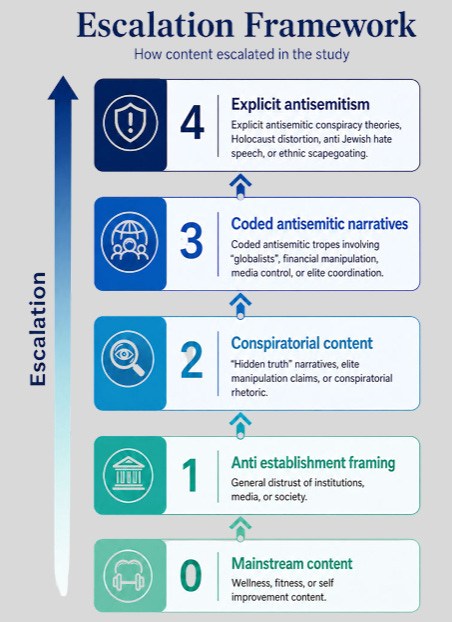
The Numbers Behind the Escalation
The wellness and biohacking account was served 59 classifiable videos over three days, and CAM classified 32.2% of them as coded or explicit antisemitism. On the third day, the wellness account received nine videos CAM classified as explicit antisemitism in a single 45-minute session.
CAM’s public data sheet describes examples involving kosher-food claims, “Hava Nagila” audio, “goyslop” memes, Rothschild banking conspiracies, Epstein-related blackmail narratives, and claims framing Israel or Jews as hidden forces behind elite abuse.
The fitness and discipline account recorded 71 classifiable videos over three days, and CAM classified 24% as coded or explicit antisemitism. On day three, that account was served 17 videos classified as coded or explicit antisemitism in one 45-minute session. CAM said the two accounts converged on similar narrative clusters despite starting in different content ecosystems.
From Wellness Content to Conspiracy Narratives
The report’s central concern is not that wellness or fitness content is inherently extremist. CAM argues that mainstream concerns about food, health, masculinity, surveillance, institutional distrust, and elite corruption can become bridges into conspiratorial narratives that eventually assign hidden power to Jews, Israel, or familiar antisemitic stand-ins.
The report identifies 14 narrative clusters, ranging from anti-establishment distrust and sovereign living to Rothschild conspiracies, blood libel themes, Holocaust rehabilitation, and a broader “puppet master” worldview.
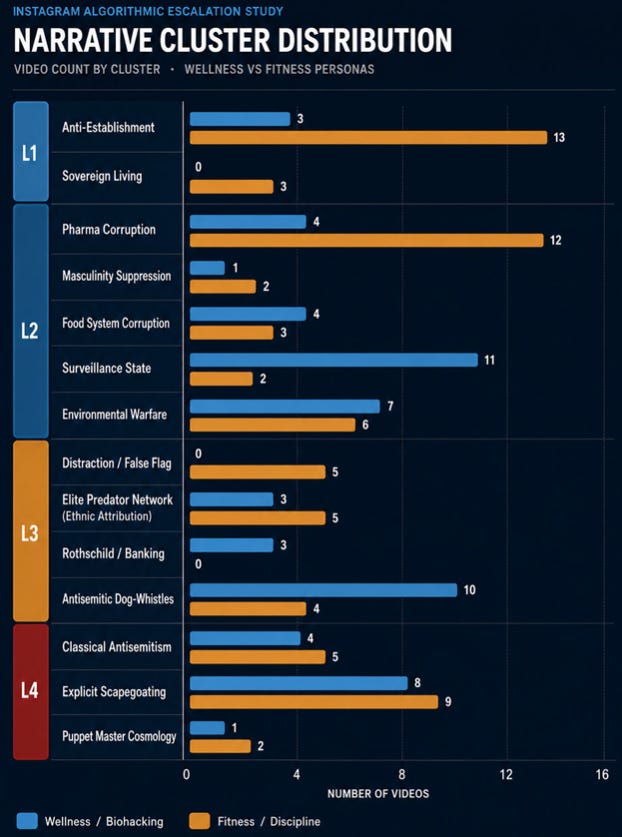
CAM described “food system corruption as subjugation” as arguably the most important entry bridge in the dataset. That pathway began with mainstream anxieties about ultra-processed food, seed oils, lab-grown meat, and institutional health failures before moving toward claims about globalist plots and antisemitic scapegoating. CAM also identified Epstein-related “elite predator network” content as a recurring bridge from conspiratorial framing to explicit antisemitism.
Coded Language that Can Evade Moderation
CAM said much of the antisemitic signaling appeared through implication rather than direct slurs. The report flagged “Hava Nagila” audio, emoji substitutions for Jews, vague “they” framing, fabricated quotes, decontextualized clips, and content warnings that conspiratorial users could reinterpret as proof of Jewish media control.
Separate research on automated toxicity scoring has found that common antisemitic codes and simple text manipulations can substantially lower toxicity scores, highlighting a possible blind spot for systems that rely on such tools.
That gap is central to the Meta question. Meta’s Community Standards apply to Instagram, Facebook, Messenger, and Threads, and the company says it may remove ambiguous or implicit content when context shows it violates the rules. Meta also says it removes content that could contribute to physical-security risks or intimidate, exclude, or silence others. Yet CAM’s findings suggest that coded antisemitism may travel through recommendation systems in ways that do not always resemble a single obvious hate-speech violation.
A Broader Warning
CAM’s report fits into a growing body of research on algorithmic exposure to antisemitism. A 2023 ADL study found that Instagram recommended antisemitic content to all six of its test personas and pushed the most graphic antisemitic material to a 14-year-old engagement persona. In April 2026, ADL said Instagram removed only 7% of 253 hateful or extremist items reported by its researchers during enforcement testing.
ISD and the Antisemitism Policy Trust reported in 2026 that TikTok recommendations exposed UK teen personas to antisemitic content, while Rumble’s “Editor’s Picks” and platform environment surfaced more overt antisemitic material.
The timing also comes as Meta is publicly trying to diversify repeated content exposure for teen users. Reuters reported on June 2 that Instagram is testing a feature to prevent teens from seeing excessive amounts of repeated themes, including nutrition, weightlifting, and anxiety content. Meta separately announced in 2025 that it would lift restrictions on some mainstream-discourse topics and focus enforcement on illegal and high-severity violations.