


Jewish Onliner is an independent publication. If you find our work valuable, please consider becoming a paid subscriber. You can also subscribe to us on WhatsApp and Telegram. Follow us on YouTube, TikTok, Instagram, Discord, and X.

The J7 Large Communities’ Task Force Against Antisemitism released its second annual report on July 29, concluding that 2025 was the deadliest year for antisemitic attacks in the Jewish diaspora since the 1994 AMIA bombing in Buenos Aires.
The task force brings together major Jewish organizations from Argentina, Australia, Canada, France, Germany, the United Kingdom and the United States. According to J7, those countries contain more than 90 percent of the Jewish population living outside Israel.
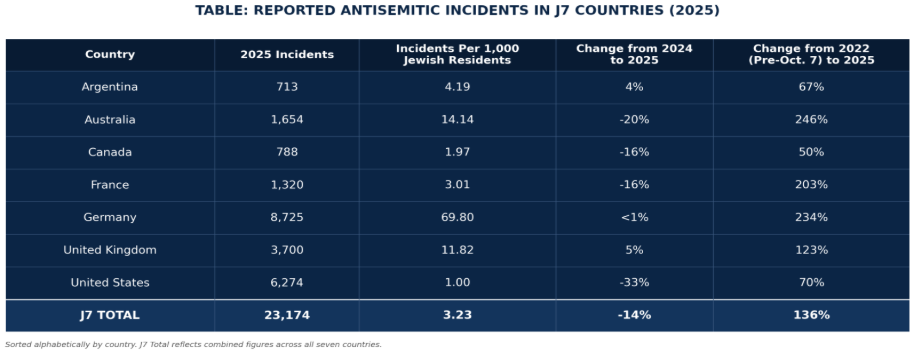
The 52-page report records 23,174 antisemitic incidents across the seven countries in 2025, down 13.7 percent from 26,857 in 2024 but 136 percent above the 2022 total. Germany recorded 8,725 incidents, the United States 6,274, the United Kingdom 3,700, Australia 1,654, France 1,320, Canada 788 and Argentina 713. The seven countries recorded a combined 91,419 incidents from 2021 through 2025.


Twenty People Killed
J7 counted 20 people killed in four antisemitic attacks during 2025. Fifteen were killed at a Hanukkah celebration at Bondi Beach in Sydney. Australia’s Royal Commission on Antisemitism and Social Cohesion describes the December 14 shooting as an antisemitic terrorist attack.
Adrian Daulby and Melvin Cravitz were killed in the Heaton Park Synagogue attack in Manchester on Yom Kippur. Yaron Lischinsky and Sarah Milgrim were shot and killed after leaving an event at the Capital Jewish Museum in Washington, D.C. Federal prosecutors charged the alleged attacker with offenses including first-degree murder, hate crimes and terrorism-related crimes. In Boulder, Colorado, 82-year-old Karen Diamond died after being injured in the firebombing of a demonstration calling for the release of hostages held by Hamas in Gaza.
J7 separately recorded 718 violent incidents across the six countries for which it had a breakdown.

Antisemitism in Mainstream Spaces
J7 identifies the normalization of antisemitism in political, professional and institutional settings as a trend connecting the country reports.
Germany’s RIAS monitoring organization attributed 807 incidents to a right-wing extremist background and 501 to a left-wing anti-imperialist background. Both categories increased 43.6 percent from 2024, although 57 percent of all German incidents could not be assigned a political or ideological background.
Statistics Canada recorded 788 police-reported anti-Jewish hate crimes. Those cases represented 71 percent of religion-motivated hate crimes, despite Jews making up less than 1 percent of the Canadian population.
The report also identifies anti-Zionism as a recurring vehicle for antisemitic expression. ADL’s U.S. audit classified 2,847 incidents, or 45 percent of its total, as containing elements related to Israel or Zionism. In the U.K., the Community Security Trust found explicit anti-Zionist motivation in 48 percent of recorded antisemitic incidents.
Campuses, Online Hate and AI
ADL recorded 583 incidents on U.S. college campuses, down 66 percent from 2024 but still nearly three times the 2021 level. In Australia, a survey of Jewish university students and staff found that 74 percent of student respondents had heard antisemitic comments. Across the student and staff sample, only 34 percent said they felt safe on campus.
J7 says online platforms are now the primary arena for antisemitic expression in most of the seven countries. Argentina classified 66 percent of its incidents as originating online, while Germany recorded 2,314 online incidents and the U.K. recorded 1,541.
The report also cites research on generative AI. One ADL test found that four text-to-video systems produced antisemitic, hateful or violent material in at least 40 percent of tests using prompts intentionally designed around extremist, hateful or violent content. Another study found harmful answers in 44 percent of test cases involving open-source language models.
Reported Rates and Government Responses
J7 calculated Germany’s reported incident rate at 69.80 per 1,000 Jewish residents, followed by Australia at 14.14 and the United Kingdom at 11.82. These rankings are subject to the same methodological differences affecting the national totals.
Surveys cited by J7 also point to widespread insecurity. In the United States, 55 percent of Jewish Americans reported experiencing at least one form of antisemitism during the previous year, while 52 percent worried about their personal safety.
Government responses included the establishment of a U.S. federal task force, continued British security funding for Jewish institutions and Australia’s royal commission. J7 nevertheless argues that government action remains too reactive and uneven.
The task force calls for stronger enforcement against antisemitic violence and incitement, national reporting systems, targeted security funding, campus protections and greater transparency from technology companies. It concludes that the killings in 2025 transformed an already elevated threat into a lethal one and require a coordinated response from governments, institutions, civil society and technology platforms.