


Jewish Onliner is an independent publication. If you find our work valuable, please consider becoming a paid subscriber.
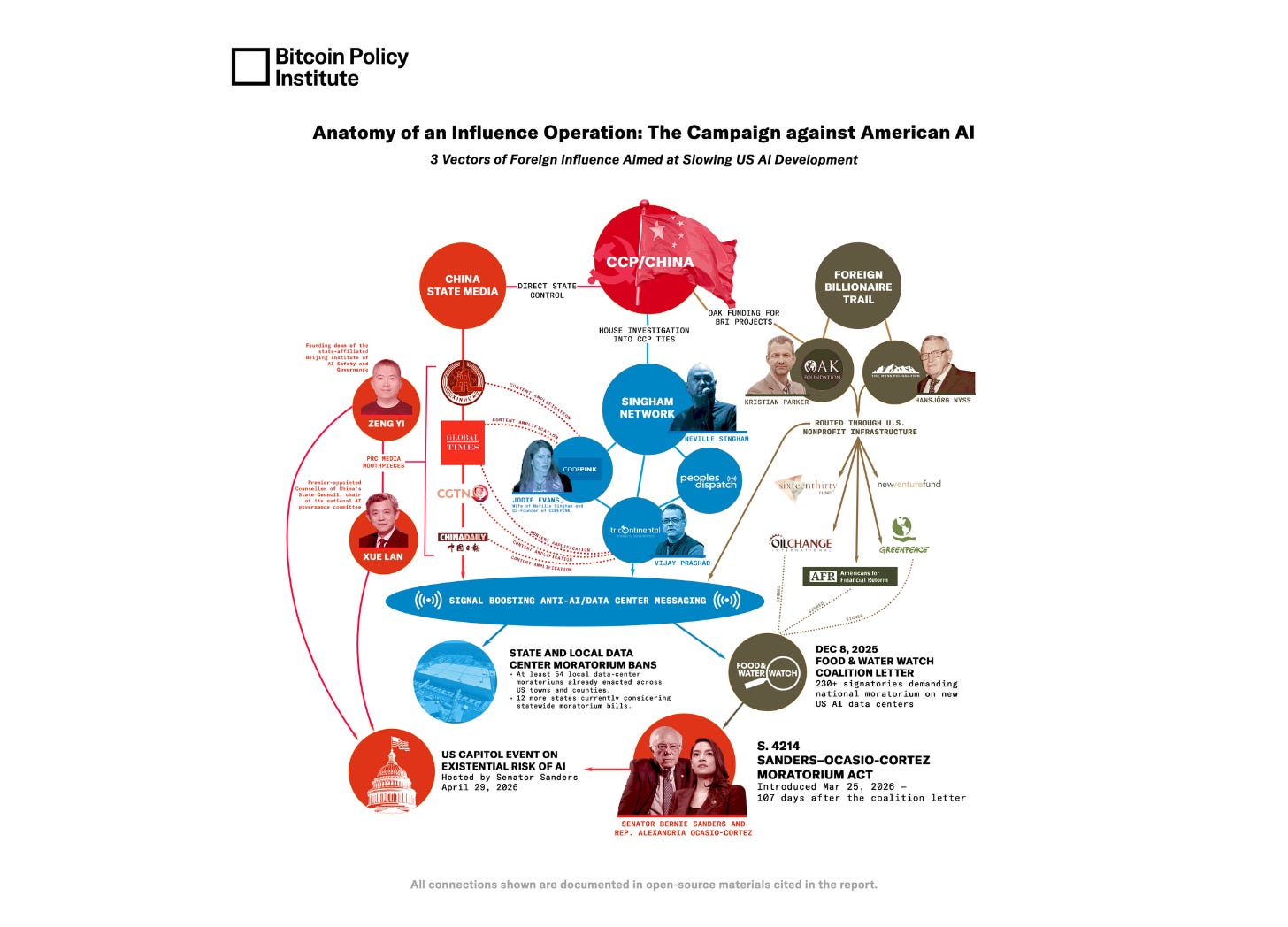
A new report by the Bitcoin Policy Institute warns that a China-linked foreign influence operation is using three converging channels to obstruct the construction of U.S. artificial intelligence data centers.
The report identifies three main vectors: Chinese state media outlets, including CGTN, China Daily, and Global Times; a CCP-aligned nonprofit network funded by Shanghai-based American expatriate Neville Roy Singham; and foreign billionaire-backed groups working to weaken American AI infrastructure.
To examine how these influence operations appear in practice, Jewish Onliner analyzed social media narratives promoted by entities named in the report. The review of 2,185 tweets posted between January 2025 and May 2026 found a striking contrast in how Chinese state media and Singham-linked outlets frame AI development in China versus the United States.
Mirror-Image Messaging in the Data
Jewish Onliner analyzed 2,185 tweets from five accounts between January 2025 and May 2026. The sample included three Chinese state outlets — Global Times, China Daily, and CGTN, which together command 18.4 million followers — plus BreakThrough News and CodePink, two US-based outlets that are part of the Singham network. Of those tweets, 2,185 substantively engaged with AI or compute infrastructure and form the analytical base for the figures below. Each tweet was tagged for geographic focus and scored against 15 framing categories including innovation, cooperation, achievement, competition, sanctions, militarism, critical harms, and environmental impact.
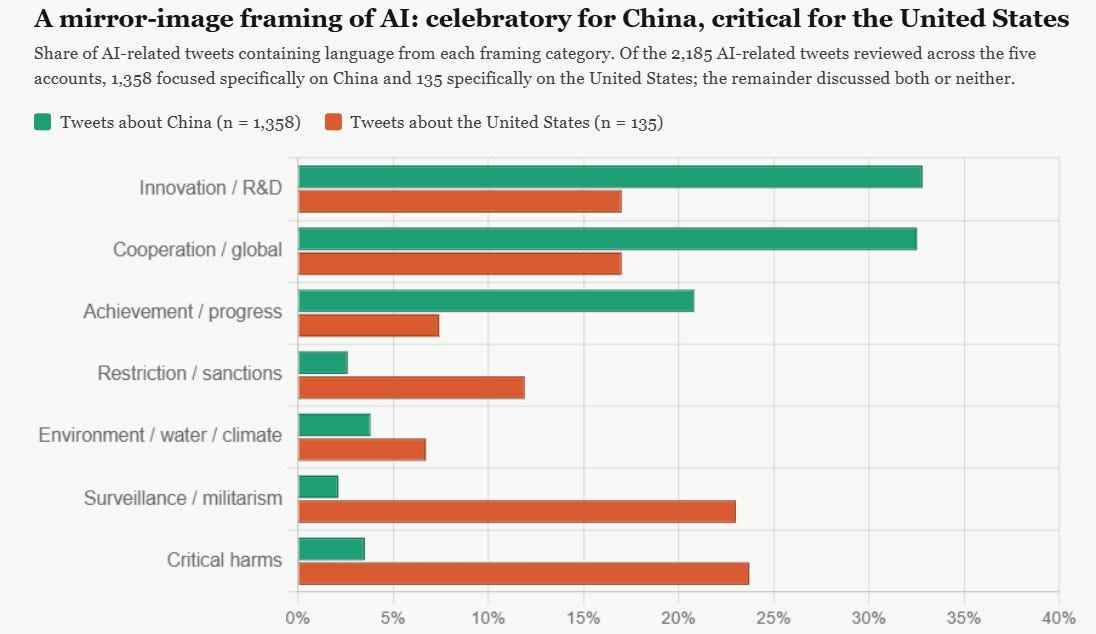
The framing asymmetry is nearly perfect. When these accounts collectively discuss AI or data centers in China, the dominant frames are innovation at 33%, cooperation at 33%, and achievement at 21%. Critical framing appears in only 3% of China-focused tweets, and environmental concerns appear in just 4%. When the same accounts discuss American AI infrastructure, the framing inverts. Twenty-four percent invoke critical harms, 23% invoke surveillance or militarism, and environmental framing nearly doubles to 7%. Achievement framing collapses to that same 7% for American content, meaning that in tweets about US AI, environmental harm is invoked as often as innovation success.
Chinese State Media Celebrates Domestic Infrastructure
Chinese state media accounted for approximately 97.3% of the AI-topic tweets in Jewish Onliner’s analytical sample, producing 2,125 of the 2,185 AI-related tweets reviewed. These accounts posted 100 to 200 AI-related tweets per month with narrative spikes around DeepSeek in early 2025 and major Chinese policy events like the Two Sessions and World AI Conference. Coverage of Chinese AI infrastructure is celebratory and technical.
Tweets highlight the world’s first wind-powered underwater data center off Shanghai, Shenzhen’s 11,000-petaflop computing cluster, underwater seawater-cooled servers that eliminate freshwater use, and DeepSeek as a gift to the global south. The environmental cost of Chinese data centers, including water and power consumption, appears in only 4% of China-focused tweets despite covering the same types of facilities criticized elsewhere.
American Infrastructure Framed as Hegemonic
The same outlets frame American AI development through recurring phrases including smearing, suppression, technological hegemony, and militarization of AI. US semiconductor export controls appear in 128 tweets, often quoting Nvidia executives criticizing American policy. Microsoft providing AI to the Israeli military is highlighted. Stargate’s 500 billion dollar investment is acknowledged but framed as evidence of how much capital the US model requires to maintain dominance. One tweet from CGTN, China firmly opposes US smearing China’s achievements in AI industry, appeared verbatim twice.
Amplification Through American Proxies
BreakThrough News, the US-based outlet in the Singham network, posts far less frequently but generates dramatically higher engagement. The outlet averages 235 likes per tweet compared to 14 to 23 for Chinese state media. CGTN has 12.4 million followers but produces the lowest per-tweet engagement.
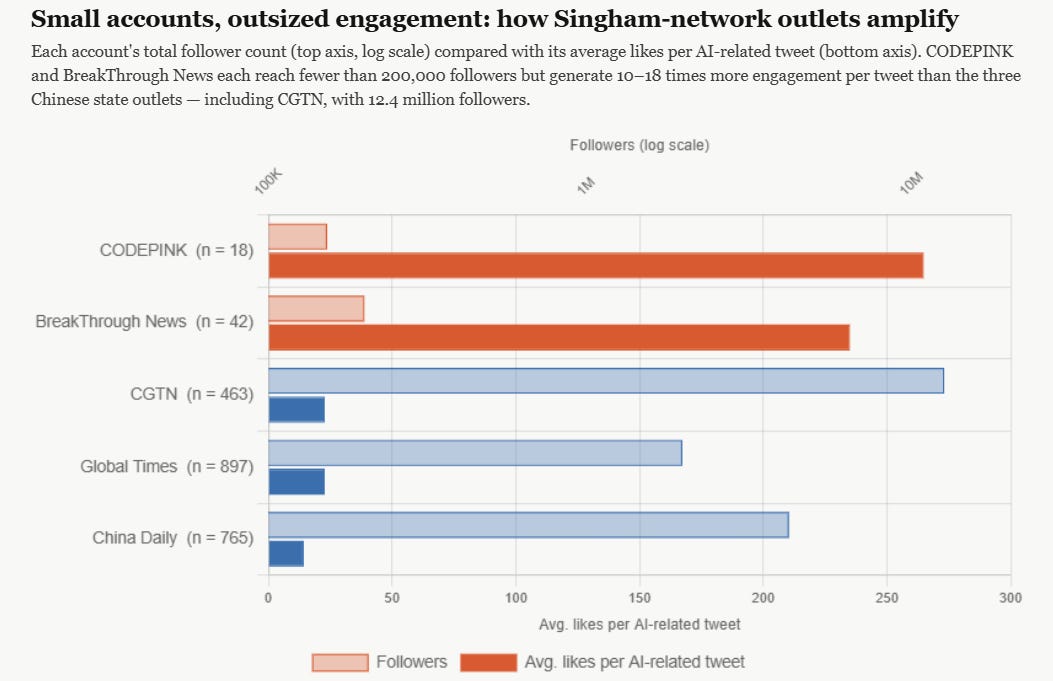
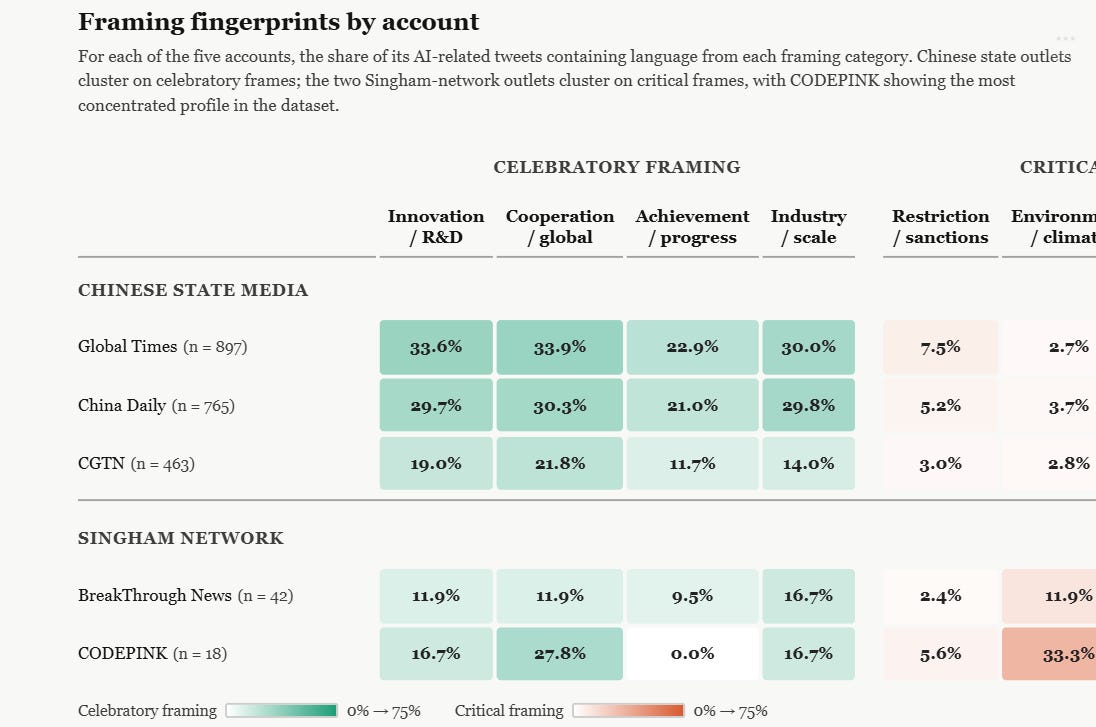
BreakThrough’s coverage primarily focuses on community resistance to US data centers in locations including Tucson, Landover, DeKalb, Mason County, and rural Minnesota, using vocabulary like environmental racism, millions of gallons of water, AI for genocide, and winner-take-all arms race. Fifty-two percent of the outlet’s US-focused AI tweets invoke surveillance or military themes. The outlet produced only two China-focused tweets across the entire period.
CodePink contributed a smaller but more concentrated stream of tweets, focused on direct-action disruptions of US AI conferences and federal hearings. 72% of CodePink's AI-related tweets invoke surveillance or military themes, the highest share of any account in the dataset, and the outlet repeatedly pairs data center expansion with US military operations in Gaza and Iran, framing the buildout as "products of and for war, imperialism, and extraction." Like BreakThrough, CodePink barely covers Chinese AI, one tweet, framing DeepSeek's January 2025 release as exposing "Silicon Valley, US empire, and imperialist economic warfare."
From Messaging to Legislation
The report argues that the messaging campaign did not remain confined to online discourse. It intersected with a broader advocacy push that sought to turn anti-data-center narratives into federal policy. On March 25, 2026, Senator Bernie Sanders and Representative Alexandria Ocasio-Cortez introduced the AI Data Center Moratorium Act, which would freeze new US data center construction.
The legislation came 107 days after a December 8, 2025 coalition letter signed by more than 230 organizations demanding such a moratorium. On April 29, 2026, Sanders convened a Capitol Hill panel titled The Existential Threat of AI, inviting two Chinese government affiliates who had spent years as featured voices in Chinese state media campaigns to advise the United States on slowing its own AI buildout.
The campaign attracted bipartisan alarm. Senator Mark Warner of Virginia called the moratorium bill idiocy, warning it would hand China a decisive edge. Senator John Fetterman labeled the legislation astonishingly stupid on national security grounds.
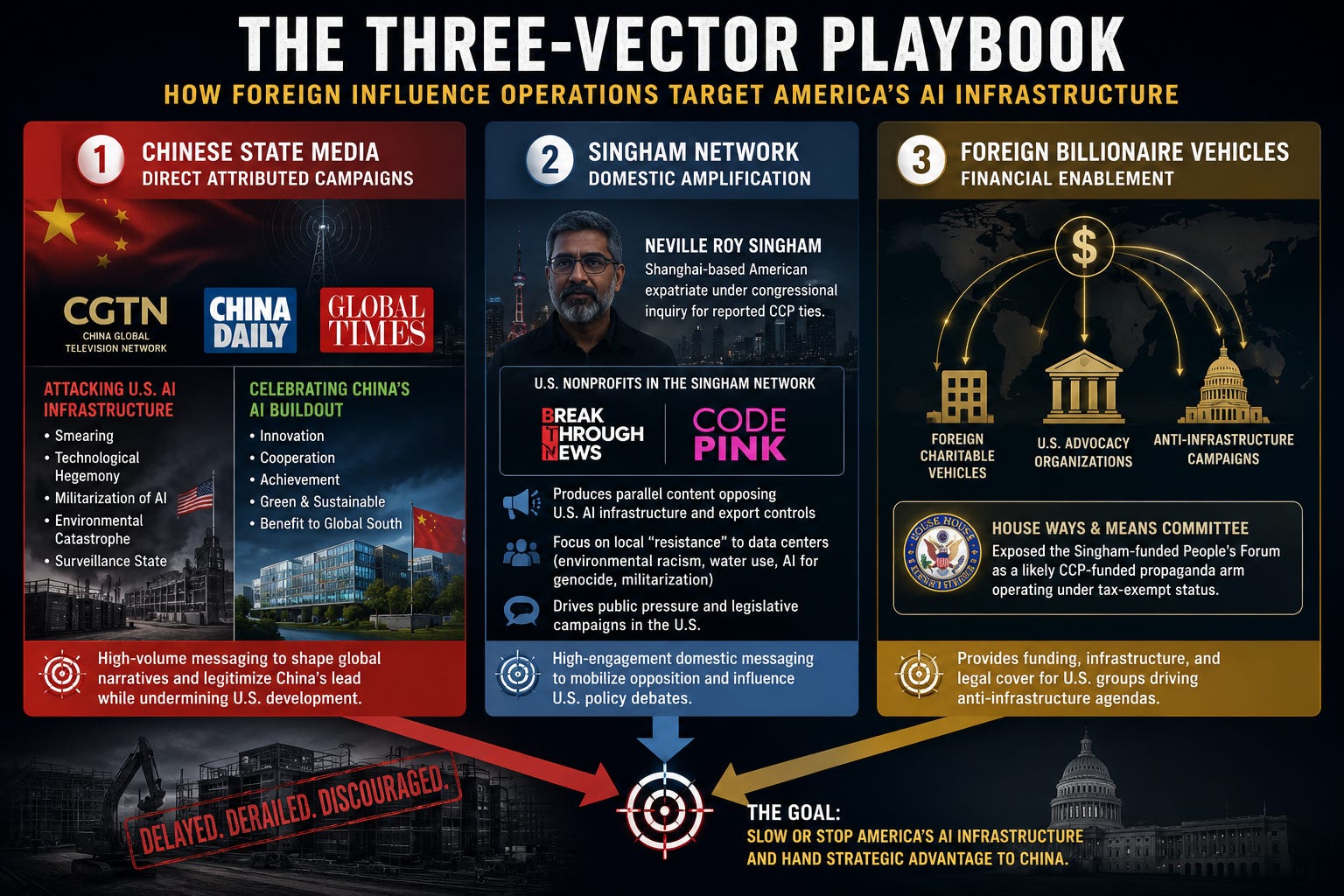
The Three-Vector Playbook
The Bitcoin Policy Institute identified three distinct channels of foreign influence.
Chinese state media outlets CGTN, China Daily, and Global Times run attributed campaigns directly targeting US AI infrastructure while simultaneously celebrating China’s own buildout.
A network of US nonprofits funded by Neville Roy Singham, a Shanghai-based American expatriate under congressional inquiry for reported CCP ties, produces parallel domestic content opposing US data centers and export controls.
Foreign billionaire charitable vehicles funnel money into US advocacy groups driving anti-infrastructure campaigns. The House Ways and Means Committee exposed the Singham-funded People’s Forum as a likely CCP-funded propaganda arm operating under tax-exempt status.
The Playbook Was Tested Elsewhere
The infrastructure executing this operation is not new. Organizations in the Singham network, including the People’s Forum and Tricontinental Institute, have spent years producing content aligned with Chinese government positions across major geopolitical issues.
The network’s most public-facing affiliate actively leads US-based BDS campaigns and maintains toolkits calling for boycotts against Israeli “apartheid”. The Singham-funded Tricontinental Institute has published extensively on Palestine using parallel framing structures. The same influence infrastructure is now targeting American AI development and technology leadership. The methodology has not changed. The target has.