


Jewish Onliner is an independent publication. If you find our work valuable, please consider becoming a paid subscriber.
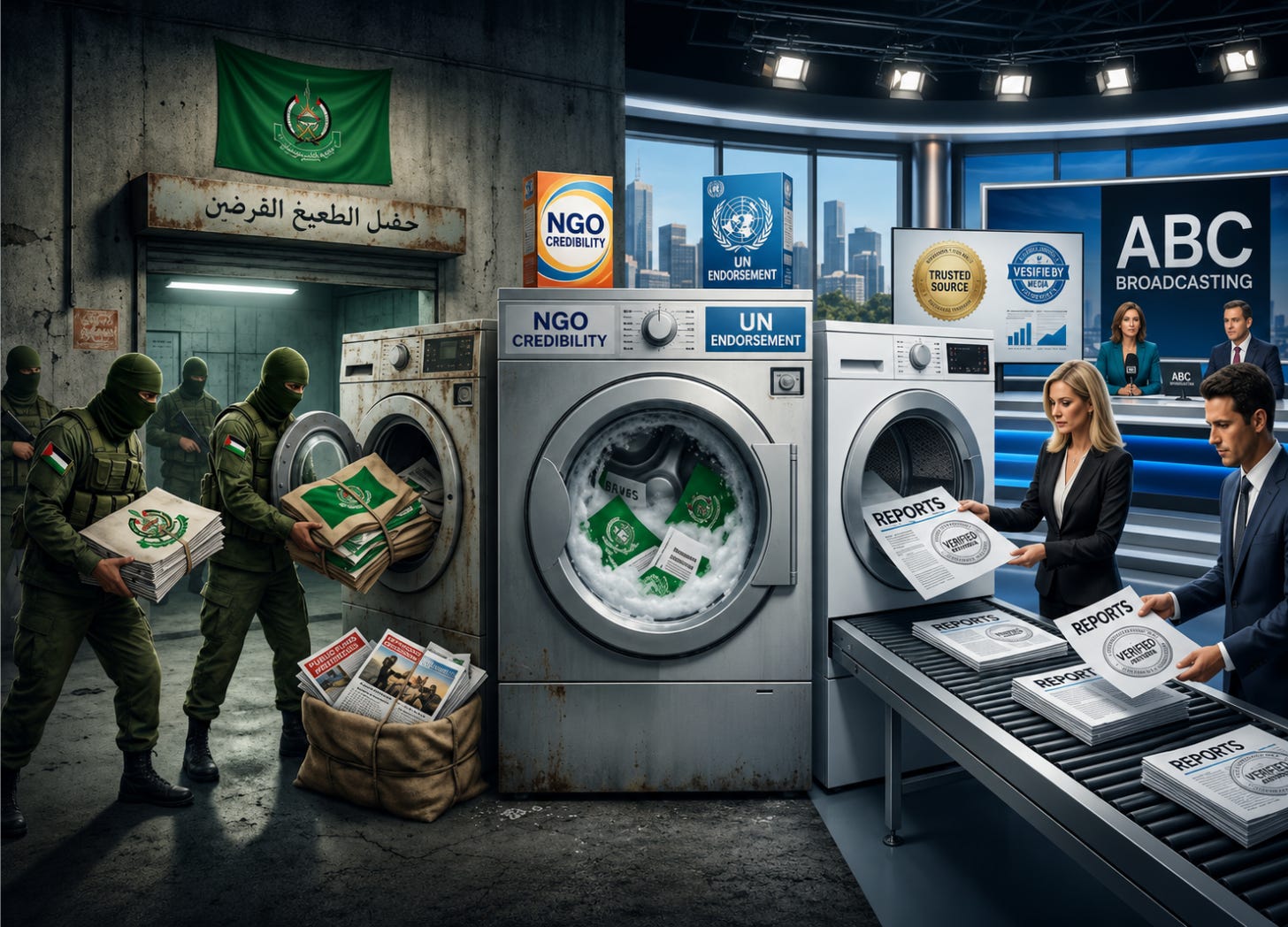
The Australian Jewish Association recently shared a two-part ABC Misinformation Report compiled by the Independent Research Group and formally submitted to Australia’s Royal Commission on Antisemitism and Social Cohesion.
According to the report, one of the clearest examples of the ABC’s failures involved its reliance on Euro-Med Monitor in coverage of false claims alleging that Israeli forces used dogs to sexually assault Palestinian detainees. The report argues that the broadcaster introduced Euro-Med to Australian audiences as a human rights source while omitting background information about the organization’s leadership and its alleged ties to Hamas.
The Euro-Med Case
When ABC News cited Euro-Med Monitor in a report on alleged Palestinian prisoner mistreatment, Australian audiences were told the allegations came from a human rights organization. What the article did not disclose, was that Euro-Med founder and chairman Ramy Abdu appeared on a 2013 Israeli list of Hamas “main operatives and institutions” in Europe.
NGO Monitor has also documented Abdu’s participation in Gaza events alongside senior Hamas officials, including Osama Hamdan. Euro-Med’s Chief of Programmes and Communications, Muhammad Shehada, has also publicly posted a photograph of himself with Hamas leader Ismail Haniyeh, according to NGO Monitor.


How Hamas-Linked Claims Become Human Rights Sourcing
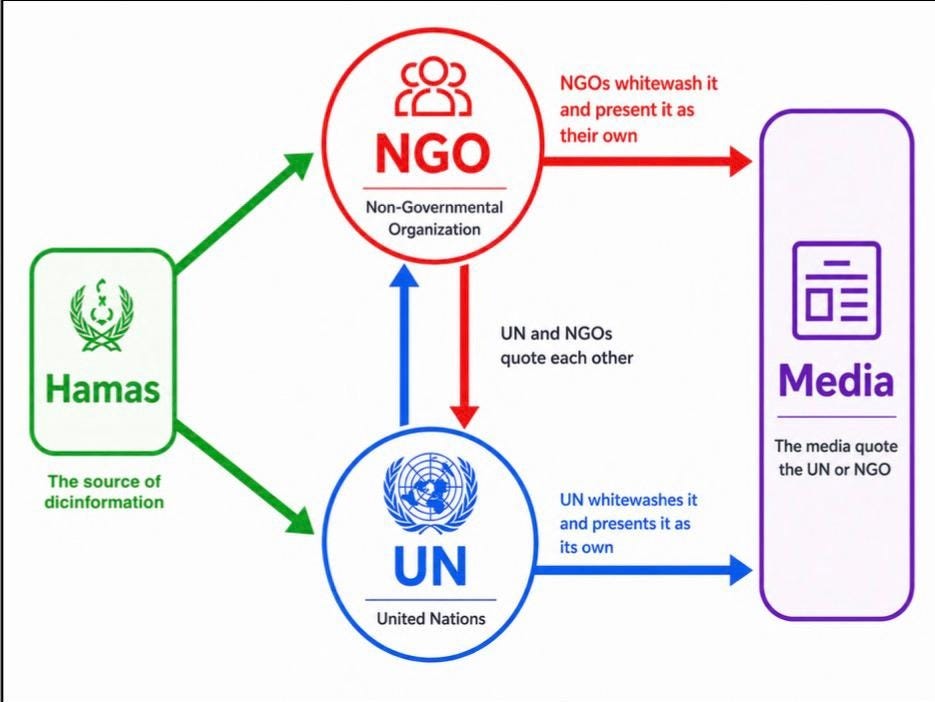
The ABC Misinformation Report presents this as part of a wider pattern it terms “Layered Attribution Obfuscation,” or LAO: the mechanism by which claims tied to Hamas or Hamas-linked sources are repackaged through NGOs, cited by international bodies, and then amplified by mainstream media until the original source becomes difficult for audiences to identify.
By the time the claim reaches Australian audiences, it has acquired the appearance of multiple independent authorities. But the report argues that, in many cases, those authorities did not generate the underlying information themselves.
The Bassal Example
The same pattern, according to the report, applied to Mahmoud Bassal, a Gaza Civil Defence figure frequently cited in media coverage of the war. The report says the ABC had acknowledged Bassal’s Hamas affiliation in at least one article, but elsewhere continued to identify him primarily as a Civil Defence spokesperson.
The report argues that this allowed casualty claims and battlefield accounts to reach Australian audiences with the credibility of an emergency official rather than the context of a source representing a terrorist organization.
“The source is obscured. The credibility is transferred,” the report states.


About 76 Percent of Complaints Received No Substantive Response
The report’s accountability findings are equally damaging. According to the Independent Research Group, it lodged 37 formal complaints about ABC coverage after October 2023 and received no substantive response to 28 of them, a non-response rate of about 76 percent. When the Ombudsman did respond, the report argues, the pattern was often deflection rather than accountability.
The Genocide Scholars Dispute
One example involved ABC coverage describing the International Association of Genocide Scholars as a leading body of genocide scholars. The report criticized the ABC’s reliance on the group after concerns emerged about its membership process and the vote behind its Gaza genocide resolution.
ABC later corrected its reporting to clarify that only 28 percent of IAGS members participated in the vote, with 86 percent of those voters supporting the resolution. Critics, including the American Jewish Committee, argued that IAGS membership was open to non-scholars, while IAGS itself acknowledged that its membership system had been targeted by fake-name spam.
The report argues that the ABC failed to adequately explain those weaknesses to its audience. “By protecting this fraudulent report,” the dossier states, “the ABC actively promoted a group of bogus anti-Israel interlopers presenting them as world authorities to legitimise a false narrative.”
The Randa Abdel-Fattah Controversy
Part II of the report also examines the ABC’s handling of the Adelaide Writers’ Week controversy.
According to the report, several ABC-linked journalists and commentators withdrew from the festival amid a wider boycott following the removal of activist and academic Randa Abdel-Fattah. Public reporting has confirmed that the festival was cancelled after a mass boycott involving roughly 180 writers and speakers.
The report names John Lyons, Laura Tingle, Louise Milligan, Jonathan Green, and David Marr among those who withdrew from the event. It argues that the withdrawals occurred in the same broader protest environment as a campaign defending Abdel-Fattah, whose public rhetoric after October 7 had drawn serious criticism.
According to the report, Abdel-Fattah celebrated the October 7 massacre on social media, adopted a Hamas paraglider image as her profile photograph, and was accused of sharing material connected to the 2024 leak of a private WhatsApp group of Jewish creative professionals. After that leak, affected members reported threats, professional consequences, business closures, and discrimination.
ABC Editorial Director Gavin Fang responded to the formal complaint by saying there was “no proof” the five withdrawals were coordinated. The report describes that response as evidence of “a protective culture that refuses to hold staff accountable for political bias.”
The report argues that the issue was not merely whether the withdrawals were formally coordinated, but whether senior ABC figures were permitted to participate in a political pressure campaign without meaningful institutional scrutiny.
Rewriting “Intifada” After Bondi
The report’s most striking example of reframing involves Grace Tame, who drew criticism in February 2026 for leading a “globalise the intifada” chant less than two months after the December 14, 2025 Bondi Beach attack, which killed 15 people at a Jewish community event. Tame also faced criticism for comments describing reports of sexual violence against Israeli women on October 7 as propaganda. The report argues that rather than confronting the full political and historical meaning of the chant, ABC coverage softened the term.
At least one ABC archive item from 2002 described the Second Intifada as “a war of suicide bombers and targeted assassinations,” linking the term directly to Hamas terrorism and the campaign of mass-casualty attacks against Israeli civilians. In 2026, the report says, the ABC recast “intifada” primarily through its Arabic meaning of “shaking off” and described it as a term associated with violent Palestinian protest.
Disproportionate Editorial Focus
The report also presents statistical evidence of disproportionate editorial focus. According to the Royal Commission submission, the report’s authors counted 539 ABC Instagram captions in 2025 about the Israel-Gaza conflict, making it the third most-covered topic on the platform.
By comparison, the report says ABC posted 197 Instagram captions about Russia-Ukraine, while Sudan, Nigeria, and other major international crises received far less attention. The report argues that the Israel-Gaza conflict received more ABC Instagram attention than every domestic issue except Donald Trump and the federal election.
A Call for External Scrutiny
AIJAC Executive Director Dr. Colin Rubenstein has welcomed the Commission’s scrutiny of the ABC, warning that “when reporting is distorted, context is omitted, or antisemitic narratives are amplified and allowed to spread unchecked, the consequences can be profound, and even lead to violence.”


The Commission’s final report is due December 14, 2026, one year to the day after the Bondi attack. The Independent Research Group’s assessment of the institution responsible for the coverage it has documented is direct: “The ABC will not fix itself. It requires serious external intervention.”